
How We Got to Minneapolis
Andrea Flores on the roots of government violence and what it will take to stop it

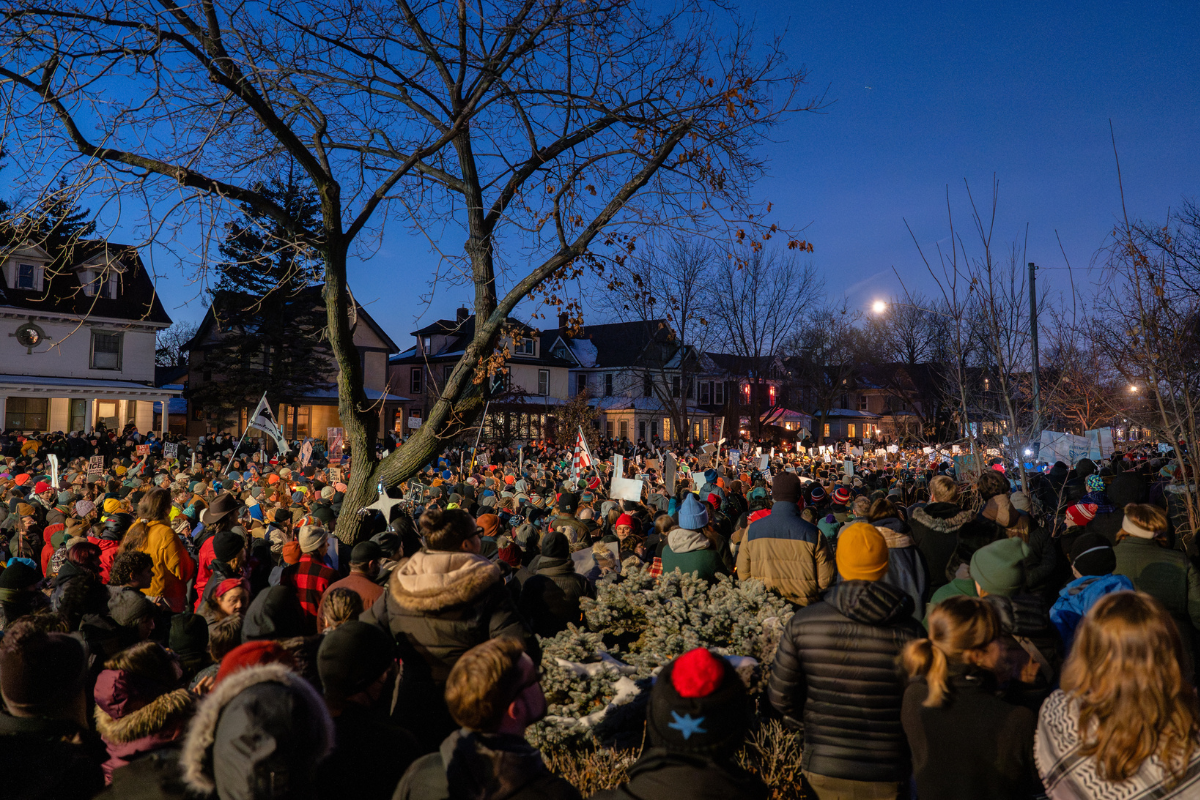
I’m still sitting — aren’t we all? — with what’s happening in Minneapolis. The media narrative has been awful to say the least, and what we’re witnessing is yet another dark stain in this country’s fractured and violent history against marginalized communities.
I am also thinking about how the 3,000 federal immigration officers deployed in the city right now are five times larger than Minneapolis’ 600 police officers. They’re behaving with arrogance and impunity. According to one press report, ICE agents ate out in one local Mexican restaurant and then detained the workers serving them.
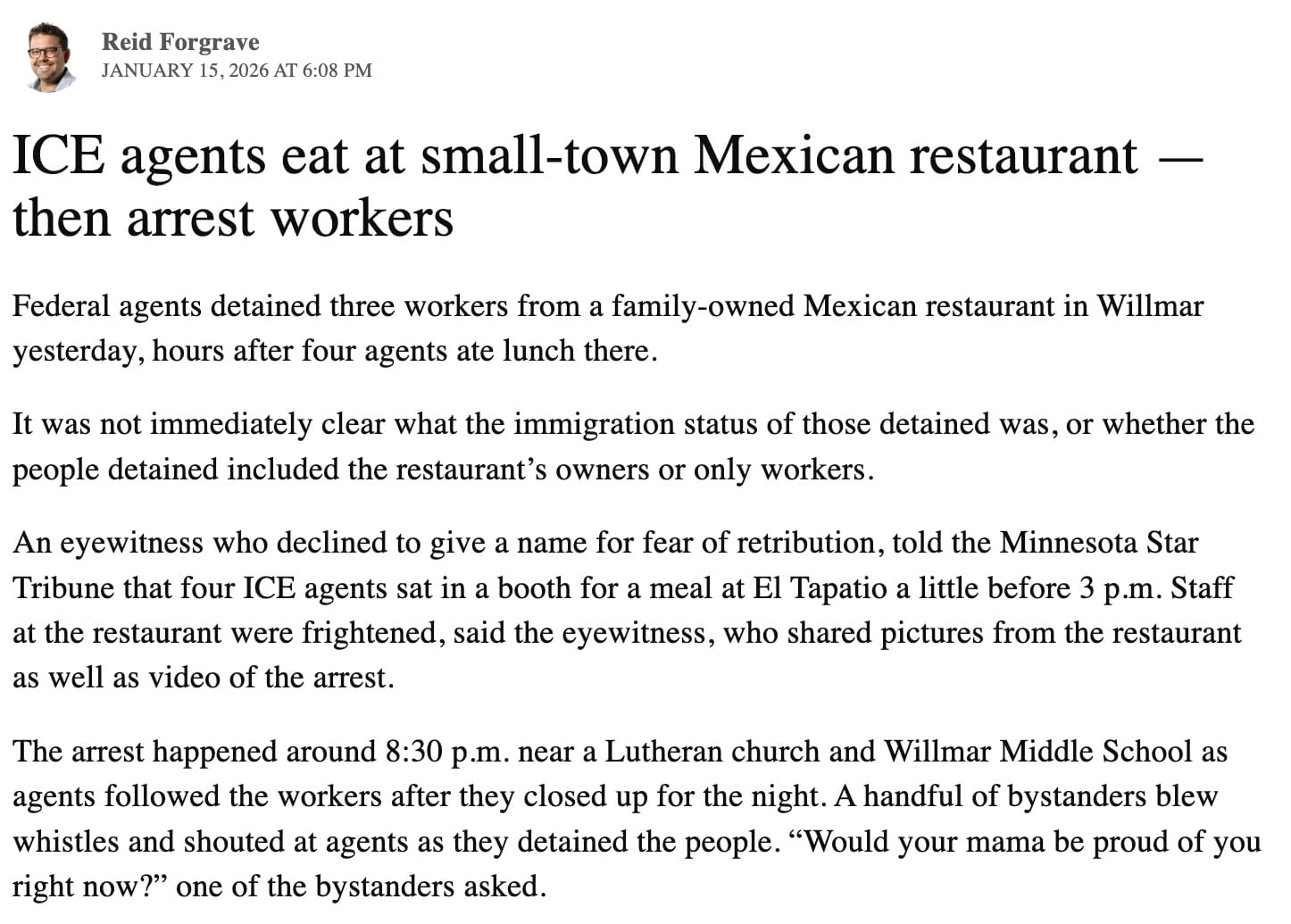
Feed us before we deport you. This is America in 2026.
When I reached out to national immigration expert Andrea Flores for today’s edition of Pressing Issues, I told her straight up that I don’t think most Americans realize how we got here. I keep thinking about the 23 years since ICE and CBP were formed after 9/11, and how this level of raw recklessness always felt baked in. But now there is a boss who is approving and ignoring their blatant unconstitutionality. Add in decades of political failure to pass a transformative overhaul of immigration legislation, and the dark path to what we’re seeing today becomes clear. Being right about all this is not a good feeling. I feel hopeless.
Flores is one of the clearest voices I know on this history and on what it has produced. She has served within DHS and the White House, helped shape policies such as DACA, worked on Capitol Hill, and led national advocacy work outside government. She has also been willing to say the quiet part out loud — including when she joined The Latino Newsletter podcast in December to share her thoughts.
Via The Latino Newsletter
So I asked Flores to walk through the context of this moment — what’s actually different now, what’s been building for years and what accountability would even look like if the public finally decided it could not live with this anymore. It doesn’t seem as if the corporate media wants to explore such topics, deciding to (once again) cover immigration like a live sporting event where individuals are just numbers and statistics in a simplistic algorithmic narrative that does nothing to make us behave more decently towards one another.
What Flores shared with me reflects an ongoing feeling that has permeated immigrant communities for years. It’s hard to see that now, as we continue to follow the events in Minneapolis, but it confirms — at least to me — that understanding the roots of such violence might be the only way to stop it from continuing.
Here’s the conversation we had.
Julio Ricardo Varela: How have you been able to process the events since Renee Good's killing on Jan. 7?
Andrea Flores: Renee Good should still be alive today, and the main reason she is not is that the Trump administration has empowered federal law enforcement, primarily ICE and CBP, to act with complete impunity. When you become a lawyer, you learn about the massive amounts of discretion that law enforcement officers have to do their jobs, but when you see an officer abuse that power and take someone’s life for no reason, it makes you rethink everything you’ve been taught.
We can’t be treating the deployment in Minnesota as an immigration issue anymore. The administration is using immigration enforcement as a pretext to invade Minneapolis, and we need to be clear-eyed that the president is using these federal law enforcement officers as his own federal police force.
He’s deploying his paramilitary force against the residents of a major U.S. city, conducting door-to-door enforcement, harassing immigrants and U.S. citizens alike, and using DHS in unprecedented ways. But moving forward, we have to acknowledge why it was so easy for him to do so. The officer who killed Renee Good has been at DHS for 10 years. He was trained under both Democratic and Republican administrations, and we need to look at the policies and funding decisions that created an agency culture where he felt free to escalate this situation and take someone’s life.
JRV: What is markedly different from DHS during this administration than in previous ones, since the agency was formed back in 2003?
AF: The way ICE and Border Patrol have been encouraged and empowered to intimidate the residents of each city they have occupied is unprecedented. There appears to be no concern for the basic legal or human rights of immigrants or native-born citizens.
There has never been an administration, not even Trump’s first administration, that directed ICE and Border Patrol to meet arbitrary arrest and deportation quotas. In Trump’s first term, ICE largely followed the policies of past administrations. Now ICE is adopting Border Patrol policies and tactics that have long been controversial for how they impact border communities. These include unfettered racial profiling, vehicle chases and acting as federal police officers in U.S. cities.
So this is not just an ICE issue. This also calls into question the role of the Border Patrol and why it has been so easy for them to be directed away from the border to harass residents in an interior city. In both administrations I served in, proposals to reform and professionalize both agencies were tabled. Now, Trump has exploited the lack of guardrails at DHS, and I don’t think we can come back from this without major reforms across the board.
JRV: Do you see this as a tipping point, or have we already been swallowed up by the divisive rhetoric that is trying to minimize this tragedy?
AF: I don’t think we are at a tipping point just yet. But that could change quickly if enforcement in Minneapolis continues to escalate. Another person was shot by ICE on Wednesday. From everything I hear, the community is terrified, people aren’t leaving their homes, businesses aren’t operating, and the longer this goes on, I think more of the country will be mobilized against these federal deployments.
But to make this a tipping point, the leaders of the Democratic Party have to help make it one. They have to be the ones showing a willingness to fight against Trump’s immigration agenda, and actually offer people an alternative vision to fight for. For too long, Democrats have failed to define an immigration system that works better, and Trump’s anti-immigrant vision has shaped our country for the past 10 years.
What we need is for Congress to reform DHS and the immigration system. And I’m so sure because I’ve served in two presidential administrations, and you cannot fix this through administrative changes. That has been tried repeatedly, and Trump’s mass-deportation campaign is evidence of how quickly the entire system can be weaponized. Only Congress can professionalize these agencies, help the undocumented, and build a system that makes sense. We have to organize the political will to make it happen, and ensure that immigration reform isn’t set aside again for other priorities.
JRV: To those who see such violence on their feeds daily right now, how best should people navigate all this?
AF: I think if you are watching what is happening in Minneapolis right now, and you are enraged and want it to change, you have to get engaged to make sure you have a member of Congress with a real vision for changing the immigration system. Because until we have candidates who are truly committed to reforming ICE and the Border Patrol, and fixing the broader immigration system, this will never really end. The politics of immigration always fall back to prioritizing the expansion of immigration enforcement over all other reforms, and while people are outraged about ICE, you already see some Democrats debating the slogan Abolish ICE instead of putting forward ideas for something better.
Open tabs
For a detailed look at how ICE is using advanced data tools to map and prioritize raids in communities across the country, read 404 Media’s investigation into the Palantir-linked ELITE app — a system that pulls in federal data into “target-rich” neighborhoods and builds interactive profiles for enforcement action. Is this the new racial profiling move for the AI Era? What could possibly go wrong?
 Joseph Cox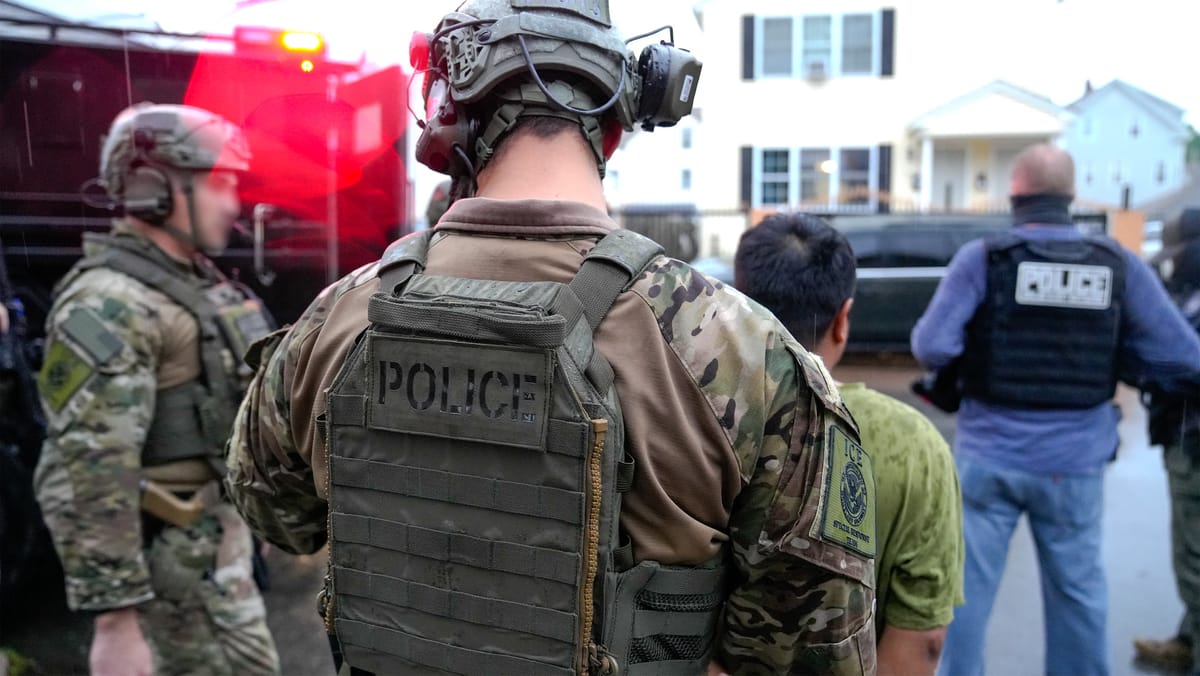
Press freedom advocates and newsrooms are sounding the alarm after the FBI executed a search warrant at the home of Washington Post reporter Hannah Natanson and seized devices in connection with a Pentagon leak investigation. The move has sent a chilling message to journalists and First Amendment defenders. The Associated Press has more here, and on Thursday, Free Press led a coalition of 31 groups condemning the action.


The kicker
“Because of what happened to Renee, I felt like we had nothing to lose anymore. Why should she be the only one who put herself in danger?” St.Paul, Minnesota resident, Ashley Lopez, in the New York Times, Jan. 14, 2026
About the author
Julio Ricardo Varela is the senior producer and strategist at Free Press. He is also a working journalist, columnist and nonprofit-media leader. He is a massive Red Sox, Knicks and Arsenal fan (what a combo). Follow him on Bluesky.