ICE, Airports and the Growing Surveillance State
The authoritarian playbook is right in front of us


Across the country, wait times at airport security checkpoints are stretching into hours far beyond the norm. People are arriving six, seven, eight hours early and still missing flights as many TSA agents refuse to show up to work after weeks without pay — their salaries having been weaponized in partisan political battles on Capitol Hill.
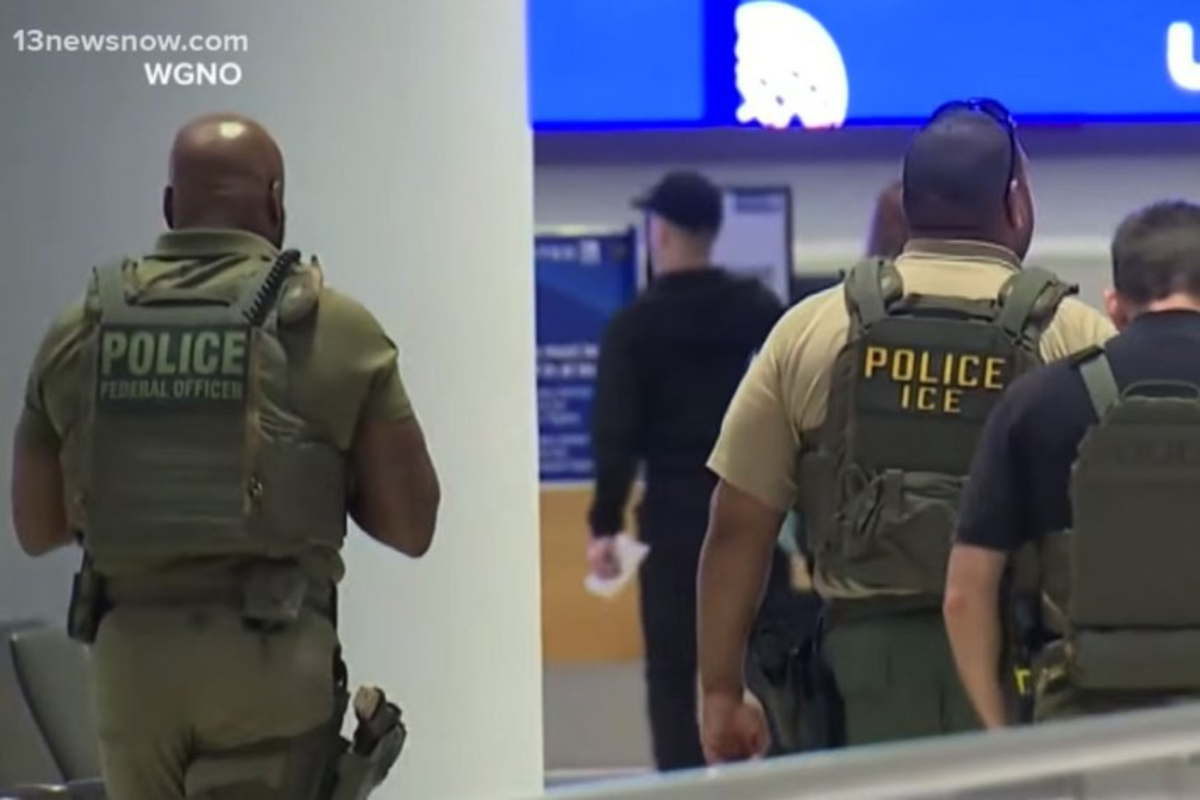
The Trump administration has seized this moment as an excuse to deploy ICE agents at major airports, introducing new layers of uncertainty and volatility for travelers. People have begun posting their own experiences and observations to social media, deepening confusion and speculation about what these ICE agents are supposed to be doing.
Between 100 and 150 ICE agents arrived at airports around the country earlier this week. That number may rise — and the mess at the airports is already serving as a distraction from the blunders and coverups Trump wants obscured, from the Epstein files to his neck rash.
The official justification from the Trump administration, repeated uncritically by a range of media outlets, is that this deployment is necessary because TSA’s anemic presence at airports —due to the longest-ever government shutdown — is creating seemingly endless security lines.
Let’s be clear: This isn’t about helping the TSA
ICE’s presence is not suddenly speeding up security lines for travelers — because the Trump administration is not actually deploying ICE agents to conduct routine screenings. Instead, reports from airports where ICE agents have been deployed show these agents standing to the side as lines continue to grow.
Meanwhile, congressional Republicans have reported that Trump intervened in negotiations to mitigate the crisis by funding the TSA — demanding instead that TSA funding be tied to a broader DHS funding package as well as to the so-called “SAVE America Act.” That legislation is a dangerous collection of unprecedented voter ID requirements that also includes discriminatory measures targeting transgender individuals.
Just four days into ICE’s airport deployments, as senators moved toward a compromise funding bill despite Trump’s demands, the president posted to Truth Social claiming he will order DHS leadership to “immediately pay our TSA agents.” What this means for ICE agents currently stationed at airports across the country, remains unclear.
In the meantime, if you’re Brown or Black or not a U.S. citizen, ICE’s continued presence casts an added chill over considerations about whether to fly at all.
We’ve seen this playbook before: Boosting the military to chill freedom
Normalizing the police state has been one of the most visible hallmarks of the Trump administration, harkening back to surveillance of Black Lives Matter protests, post-9/11 targeting of Muslims and even Civil Rights Movement operations like COINTELPRO, in which the FBI engaged in sophisticated surveillance operations to crack down on “dissent.”
Today, images and videos flood social media showing federal law enforcement’s brutal treatment of people, particularly immigrants, protesters and the press. This treatment is not happenstance but a strategic move to further normalize military presence and violence.
The Department of Defense won’t deny plans to activate the National Guard in all 50 states and “quell unrest” ahead of the 2026 midterms. Former Trump adviser Steve Bannon has said that ICE deployments at airports are an opportunity — a “test case to really perfect ICE’s involvement in the 2026 midterm elections.” This is, in part, an effort to erode the concept and practice of free and fair elections.
 Ari Berman
Minneapolis, Portland and elsewhere — has ushered in aggressive surveillance of protest gatherings, ICE’s disappearances of U.S. citizens and immigrants alike, and a deeply chilling environment where people must weigh the potential consequences of exercising their basic First Amendment right to assemble.
The government also has targeted immigrant reporters, including Mario Guevara and Estefany Rodríguez, for their coverage of government officials. It even deported Guevara for his work as a journalist.
Therefore, we must recognize the latest ICE deployments for what they are — a symptom of Trump’s chilling and authoritarian agenda. Military and police presence should never be a normal part of everyday democratic life.
We must mobilize to stop the growing surveillance state
While ICE agents fan out to airports, the Trump administration is rapidly expanding other branches of its surveillance apparatus. Border Patrol is buying access to real-time phone location data through online advertising networks. Federal agencies are partnering with firms like Flock, Palantir, Clearview AI and other surveillance-friendly companies that are blanketing our neighborhoods in cameras, gathering our data, monitoring our locations and selling the most sensitive personal information to the highest bidders.
Meanwhile, the White House is trying to reauthorize a controversial government surveillance authority without critical, broadly supported reforms to protect against well-documented abuses. Section 702 of the Foreign Intelligence Surveillance Act (FISA) has previously enabled agencies like the NSA and FBI to conduct millions of warrantless “backdoor” searches into the calls, texts and emails of people in the United States, including those of journalists, protesters and members of Congress. Within the Trump administration, Stephen Miller is a “leading advocate” for reauthorizing Section 702 without reform, seeing it as “critical to a variety of homeland security missions.”

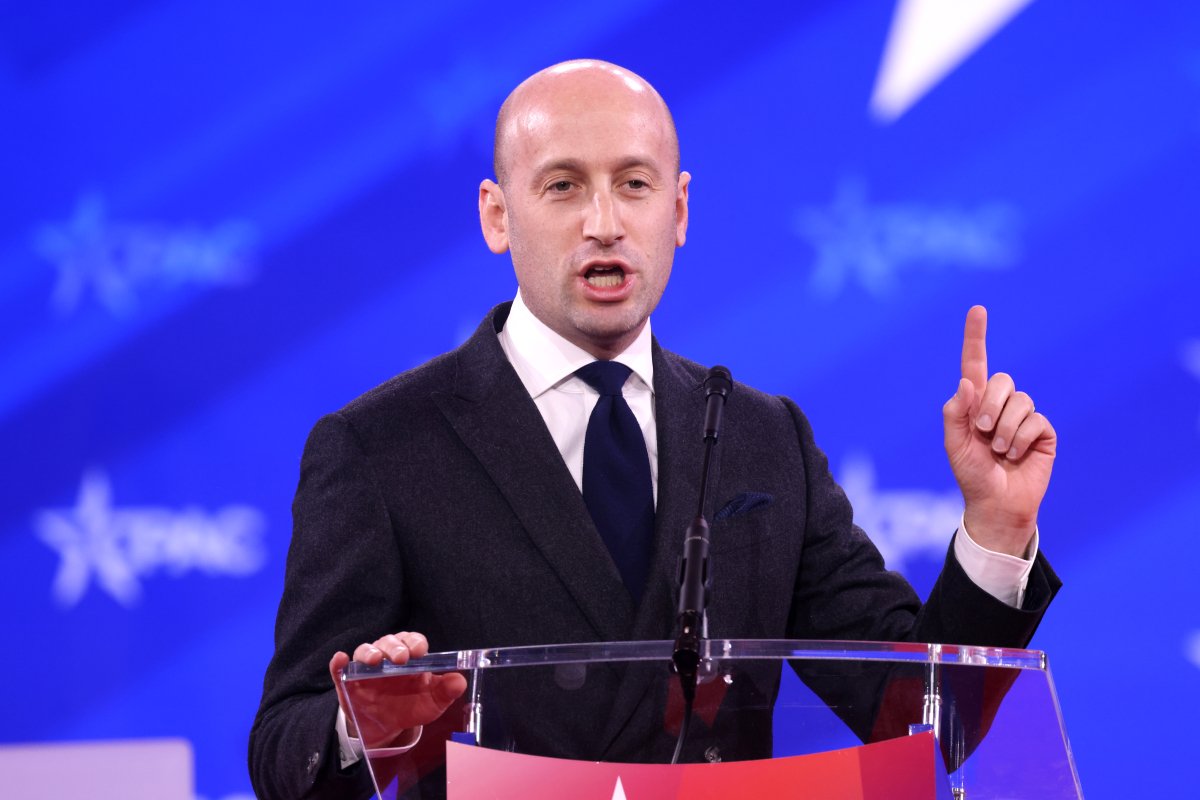
The risks of giving Miller what he wants are terrifying: reauthorizing government surveillance powers that are ripe for abuse as the Trump administration broadcasts its intent to criminalize those who dissent against or displease the president in any way. Yet people across the country and on both sides of the aisle overwhelmingly support reforms to Section 702 — just as they overwhelmingly support restrictions on law enforcement’s ability to tap into commercial data for the purpose of conducting mass surveillance, and oppose more funding for DHS and ICE.
The inescapable presence of ICE agents in airports is just one more indicator that life as many once knew it isn’t the same — but also that this playbook is wildly unpopular. This doesn’t have to be the new normal. We must stand up for our civil and constitutional rights — above the authoritarian desires of the Trump administration.
About the authors
Nora Benavidez leads Free Press’ democracy, free speech and tech initiatives, including its policy, legal and campaign efforts to curb disinformation, hate and other manipulation online while protecting digital civil rights, privacy and free expression. Follow Nora on Bluesky.
Jenna Ruddock supports Free Press’ policy, legal and communications work across issue areas, with a focus on technology, surveillance, digital civil rights and dissent. Follow Jenna on Bluesky.
Teamwork
Compiled by Pressing Issues editors
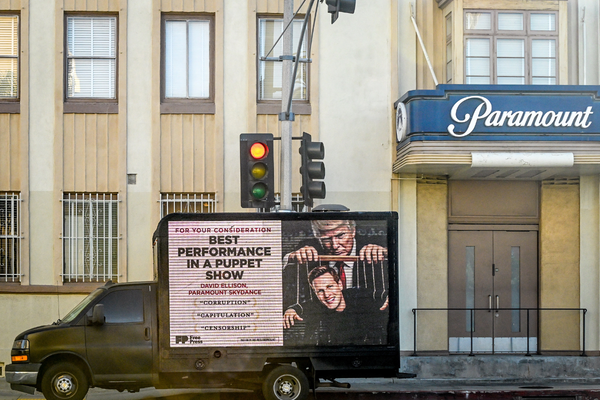
Free Press rode around the streets of DC on Thursday in a mobile protest of Federal Communications Commission Chairman Brendan Carr, which included protesters outside the FCC building with duct tape covering their mouths while wearing "Censorship Czar” t-shirts.
The mobile billboard caught the attention of Carr on X — though unlike local broadcasters, he hasn’t yet threatened to take away the truck driver’s license.
He joked with reporters about the photo showing him when he had more hair. He used to be someone who opposed government censorship, too.
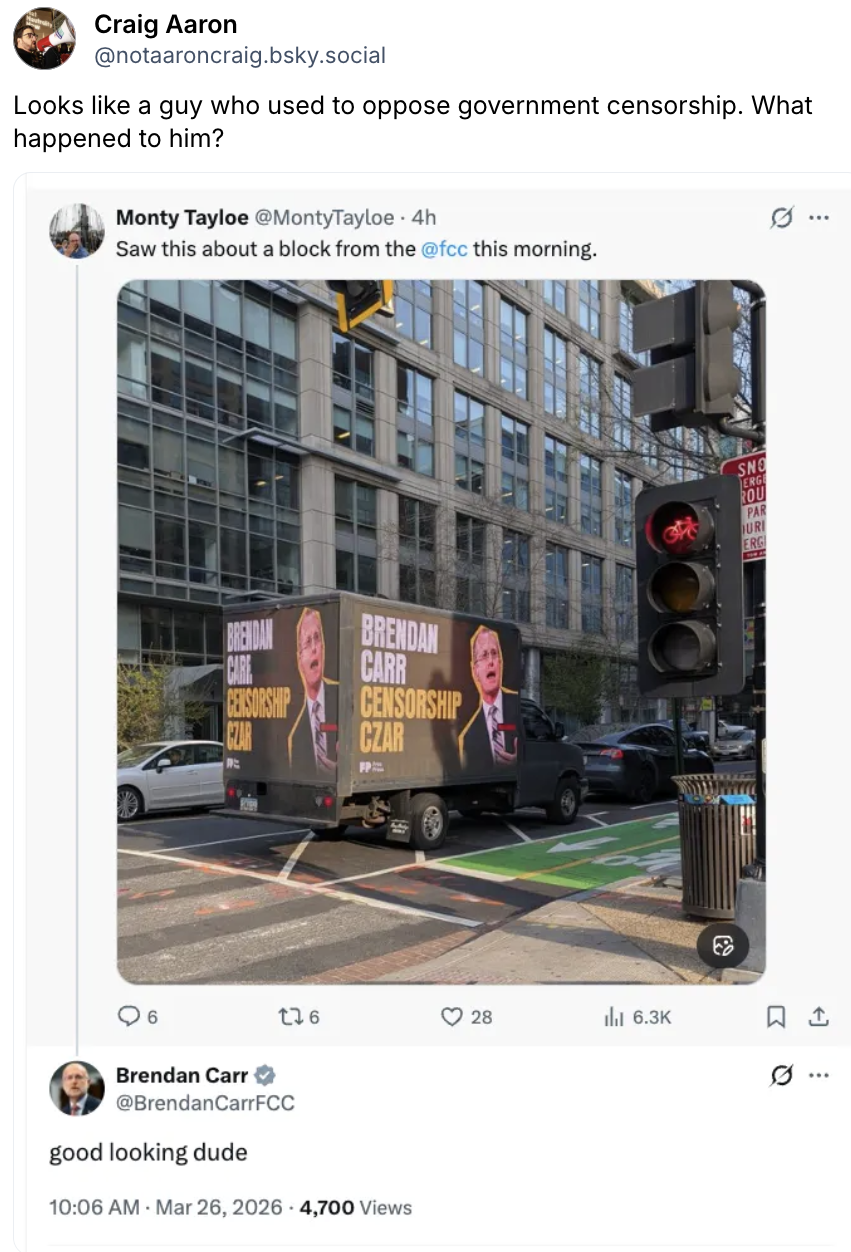
Here are photos from Thursday’s ride.
While protesters were in the streets, Matt Wood, Free Press’ vice president of policy and general counsel, was up on Capitol Hill testifying at the Subcommittee on Communications and Technology about the successes and failures of the Telecommunications Act of 1996.
“Such discussions about three decades of change often look back to laugh at now quaint-sounding tech trends and touchstones,” he said in his opening testimony. “Yet there are timeless principles in the 1996 Act: places your predecessors … got it exactly right — not always in the terms they wrote, but in the values they espoused. Sadly, the Trump administration is trashing many of those values.”
He used his testimony as a chance to point out how far Brendan Carr and the Trump FCC have strayed from the law’s purpose and Congress’ instructions. “This FCC chairman ignores facts, laws, even the Constitution, when he pleases — so long as it pleases this president,” Wood said. “He attacks free speech and freedom of the press. He threatens broadcasters for coverage he doesn’t like.”
The kicker
Hulk hate censorship!