On Local News Day, a National Call to Transform Journalism
The need for truthful, community-rooted news and civic information has never been clearer

Today, April 9, is the first-ever Local News Day, a call to action organized by nonprofit newsroom Montana Free Press that aims to reconnect people across the country to trusted local outlets.
More than 200 partners — including here at Free Press— and 1,300 newsrooms are participating, and to celebrate Local News Day, the Pressing Issues team is publishing a bonus edition featuring Alex Frandsen, Free Press’ journalism advocacy director.
Alex was a guest on FAIR’s CounterSpin radio show with host Janine Jackson, and they discussed how Local News Day fits into the work that Free Press and Media Power Collaborative are delivering to transform the local news movement.
 CounterSpin
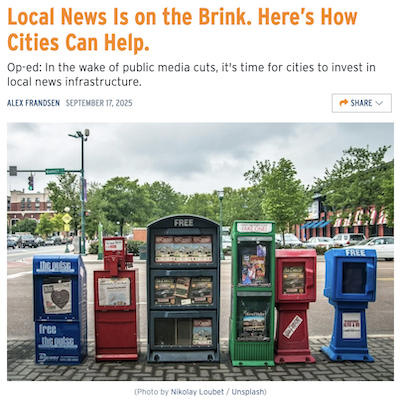
Alex also filed an opinion piece for Local News Day that Governing just published.
Jabari Simama
Here is an edited transcript of Alex’s interview on CounterSpin.
Janine Jackson: The work of defining what communities need from news and doing that by actually listening to people instead of talking over them, the work of engaging policymakers in addressing those needs, this is not the work of a day.
This is long-term work. Still, focus points can be helpful in calling attention to these ongoing issues, so could I just ask you to start with the idea of something like Local News Day and how that sort of individual event or effort can tie into the longer-term work you do?
Alex Frandsen: In a lot of ways, this first Local News Day is coming at a really critical inflection point that communities and journalists are feeling across the country right now, which is that the role of truthful, community-rooted local news and civic information has never been more clear in the overall health of our democracy and of our communities. I think folks are feeling the deficits on that front more acutely than ever. We’re not going to solve everything on Local News Day, of course, but any time you have a news peg like this to draw people into issues in a concrete way, give them something to rally around, it's instrumental to building the kind of long-term organizing and awareness we need in this field.
Many folks in the media world have been talking about the struggles and collapse of local news over the past few decades, but what hasn’t happened quite yet is whether this has become a true public-interest issue with broad public buy-in. That’s absolutely changing. Events like Local News Day are one of our best avenues to ramp up engagement at the community level.
JJ: And anyone who’s engaged with the media knows that often journalists will say, “Well, what's the peg? What's happening this week that will allow me to delve into these ongoing issues?” Last fall, you wrote a piece at Next City, and it led with a complaint from the former mayor of Greensboro, North Carolina, Nancy Vaughn, who said, “A city of Greensboro’s size and significance deserves stronger [news] coverage. It deserves a news ecosystem that reflects its energy, complexity, and future. Supporting local reporting isn’t just about newspapers — it’s about sustaining an informed, connected community.”
To me, that sounds like a media critic — it's meaningful. I think that public officials, who many of us think make the deals that allow things to be bought up and priced out, are themselves among those noticing the harms of this increasingly barren news landscape.
AF: Absolutely. It also reflects a growing awareness among lawmakers that local news is way more than the industry. It’s a genuine public good that we need for the functioning of our democracy.
You can’t engage with your community, hold leaders accountable or create change if you don’t have ways to understand what’s happening around you. So when you look around at some of those pressing challenges facing folks all across the country at this moment, accurate local news information almost feels like the raw material, the prerequisite thing you need to create the structural change we know we need. It’s not just one mayor, but dozens and dozens of lawmakers at the state and local level across the country who step up and say, “This is not just an industry crisis. It’s a public crisis, and it deserves public action.”
JJ: The Media Power Collaborative that you work with has a sense of what needs to happen, and these things are always works in progress. Talk us through the key elements of the agenda you’ve landed on.
AF: It ties into the broader historical reality in the United States, which is that we've never really treated local news like the public good that it is. For the most part, we’ve treated it like an industry, like a business.
When newspapers are pulling a lot of ad revenue, we could pretend that was okay because business is booming. But even when business was booming — relatively speaking for the newspaper industry — there were countless communities that were left undercovered, underserved, even outright maligned by the media.
Just like in so many other parts of our society, access to and resources in local media have been and continue to be shaped by these deep inequities, and we know the commercial market isn’t gonna fix those inequities on its own. That’s where this concept of public investment and public policy change really comes in.
In the 20th century, there was a long organizing effort to push for public investment in our local media system, and it worked. It culminated in the creation of the Corporation for Public Broadcasting, which was really built on the specific premise not just to keep the local news industry afloat, but to provide the kind of public-interest coverage the market simply wasn’t providing, with this explicit focus on underserved communities — local media for all.
But the reality is that the system was never adequate to fully fill the gaps left by the market, and as the local news industry has collapsed at an alarming pace over the past few decades, those gaps have become outright chasms. Corporations, hedge funds and billionaires now own a massive proportion of our media system.
They’ve hollowed out newsrooms, laid off journalists and consistently put profits over the public interest. It’s the news information gaps that have always existed to an extent, especially in rural communities, communities of color and working-class communities. Those gaps have just gotten wider.
And now with the defunding of the Corporation for Public Broadcasting at the federal level, you’re seeing this final nail in the coffin that was already pretty close to shut when it came down to our underinvestment in local news. But even amid a really depressing federal landscape on many levels, we’re seeing an incredible surge of interest at the state and local levels in supporting local news.
We’ve got more than a dozen states exploring some sort of legislation to support local news. Parallel to that, we’ve also got this growing collection of independent publishers, community newsrooms, nonprofit newsrooms, startups and BIPOC media outlets that are increasingly stepping into the biggest gaps left behind by the collapse of the market.
These folks are essentially charting the transformed, community-rooted future of local news, hopefully taking us beyond the consolidation and hyper-commercialization we’ve seen over the past few decades. Especially post-CPB, state lawmakers are right now charting a new future for publicly funded and publicly supported media in this country.
Will this policy change lead us into a more sustainable future for the local news field? Or are we going to be content keeping our current media system afloat as is? Our feeling with the Media Power Collaborative is that if we’re talking about public dollars, that comes with real public-interest priorities, and we need to ensure that policy change is centering not just the needs of industry, but the communities themselves that are the consumers and actors with the local news information that general providers are creating.
Our policy agenda is organized into distinct pillars. It’s tasked with all these different kinds of legislative approaches that lawmakers can take, but if we just sum it down, it comes down to a few core points:
- High-quality local journalism is a public good that benefits entire communities.
- Our current media system — dominated by chains, hedge funds and broadcasters — is too often beholden to shareholders instead of community members.
- In the shadow of corporate giants, the outlets closest to their communities and best equipped to meet their needs are really left to struggle over a meager pool of resources.
- Working-class communities, rural communities and communities of color are really feeling the news information deficit most acutely.
With those principles at heart, the policy agenda tries to point lawmakers toward the values and the core question and the concrete tools at their disposal to not just throw a life raft to the media industry that has long existed, but really make sure policy change is pointing us toward the sustainable, equitable, community-rooted future that we still badly need for our local media system.
JJ: I’ll just finally underscore the word you used, which is transformative. We are not trying to recreate or buck up an existing system, and listeners will know that FAIR has had decades of problems with CPB, PBS and NPR in terms of fulfilling what their on-paper mission was, but this is about clarifying what communities need and actually starting the conversation. I think that’s what’s so different — starting the conversation from communities’ information needs, rather than from how can we support particular news outlets. That might sound linguistic, but it's actually hugely important to start the conversation in a different place.
AF: Ultimately, journalists are key stakeholders in the future of our media system. There’s absolutely no doubt about that, and we need to figure out a way to stop the job-loss crisis in our local media system, to stop the hollowing out of newsrooms and to keep this thing from collapsing entirely. But long term, we also need to understand that consumers, readers and community members themselves are critical stakeholders in the health of our media system.
And when we can bring them in, not just like passive bystanders to what’s happening to local media, but as active participants in this movement to reinvent, to create something that truly serves their needs — and not just the needs of folks in corporate boardrooms or who worry about quarterly profits — that will lead to a more impactful policy change and inclusive discussion.
This will point us towards a kind of long-term, sustainable and transformative solution that this moment is really laying bare for us right now.
Open tabs
On Wednesday, about 150 ProPublica workers went on strike for 24 hours as contract negotiations stalled. The New York Times reports that workers — who formed a union in 2023 — were calling for higher wages and protections against layoffs, as well as more transparency and clarity about how ProPublica uses artificial intelligence in journalism.
“ProPublica is its workers, and when more than 100 people step away from their work for a day, that’s significant,” ProPublica video journalist Katie Campbell told the Times. “We want to get back to work, but we want a fair contract to do this work.”
The kicker
“In these experimental days, policymakers can and should explore a broad variety of ideas. From fellowship programs to tax credits to government advertising set-asides, there are plenty of levers to pull. But it’s clear that the higher goal should be to create durable public infrastructure for local news and civic information. Instead of patching holes in a rapidly sinking ship, we need to design a sustainable system for supporting the media outlets best able to serve their communities.” —Alex Frandsen in Governing