Attorneys General Cave to Paramount’s Extortion Threats
But the growing movement fighting the authoritarian takeover of the media won’t stop

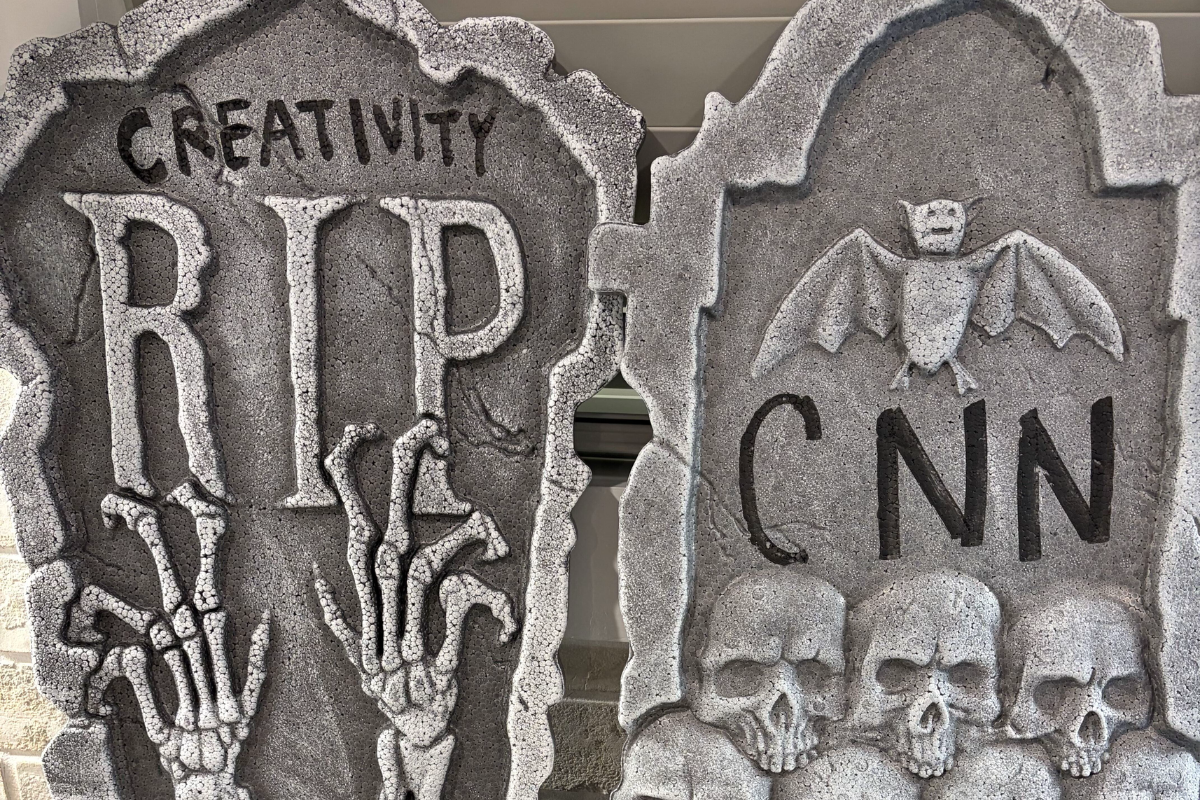
I’m on my way to Hollywood today with a trunk full of gravestones.
OK, they’re made of foam, and I picked them up at Michaels before scrawling RIP to “CNN,” “creativity” and “free speech” on them.
My homemade artwork doesn’t capture my anger, betrayal and deep disappointment after 12 state attorneys general settled their lawsuit against Paramount on Monday, clearing the way for the company to swallow up Warner Bros., HBO, CNN and so much more. It can’t convey the outrage I feel at how quickly the state attorneys general folded and how little they got after promising to put up a fight.
So I’m headed back to the Paramount lot to protest alongside the actors, filmmakers, writers, workers and advocates who have fought so hard to block this deal because they know what it means to the future of our media and our democracy. We’re mad as hell — and, thanks to all the capitulation and corruption on display, there are a lot more of us ready to fight back and reclaim our media system from the billionaires and their enablers.
Don’t know when to fold ’em
After months of promising to block the Paramount-Warner Bros. Discovery mega-merger — or at least force the companies to sell off major parts of the combined businesses — California Attorney General Rob Bonta signed off on a weak settlement full of empty, unenforceable promises. The settlement contains no real protections for workers and nothing constraining the Ellison family from warping CBS’ and CNN’s journalism to serve Donald Trump.
Why did Bonta cave? I don’t know what was said in the boardrooms. But after Paramount Chairman and CEO David Ellison threatened to move his movie studio to Tennessee or Texas, Gov. Gavin Newsom, gubernatorial candidate Xavier Becerra and L.A. Mayor Karen Bass all pushed for a settlement. And Bonta’s resolve disappeared.
 Winston Cho
Since California was leading and paying for the antitrust lawsuit, once it backed down, it was just a matter of days before the other 11 states decided to settle, too.
Paramount was staring down a daily $7 million “ticking fee” starting next week, which explains why its lawyers were pushing so hard to make a deal. But why would the AGs surrender this leverage?
There’s an election in six weeks that might tell a politician something about how the public feels about billionaires. Those results might have proven useful in negotiating a settlement. So might the information the AGs would have gleaned from discovery and deposing Paramount’s executives before the scheduled trial next March. Now we’ll never know what they might have uncovered.
You don’t become as rich as the Ellisons without experience in arm-twisting extortion. But in their wildest dreams, they can’t have thought it would be this easy. And for what?
Bad behavior
Behavioral conditions don’t work. They don’t save jobs, preserve choice or prevent price hikes. But you don’t have to take my word for it. Just ask Rob Bonta.
“We’re not interested in behavioral remedies — empty promises, self-serving promises, promises that are unenforceable, that won’t be kept, that history shows won’t be kept,” the attorney general told CNN in July.
Now he’s agreed to exactly that: a toothless set of unenforceable commitments, weak oversight and empty promises on movie production that amount to far less than what both companies were already doing on their own. As much as Bonta and his colleagues try to spin the settlement, the details show they sold us out for peanuts.
For starters, Paramount will not have to make any more movies than it currently makes. While Paramount and Bonta touted a “30 films a year” promise, the settlement requires that they produce or jointly only produce 15 films a year, while distributing others. They produced 18 films combined last year.
The AGs didn’t get any structural concessions. Paramount doesn’t have to divest any cable channels up front — only promise to negotiate fairly with cable companies in the future. Good luck ever enforcing that.
And according to the settlement’s fine print, it will be null and void if there is a strike, a “labor disruption” or an “economic recession.” That’s a big get-of-jail-free card with a side of union-busting incentives.
Plus, the whole thing expires in five years. At its best, this is a temporary and partial fix that shields theaters against rate hikes (for three of those years, anyway) and puts a little money into the Writers Guild’s coffers. (At least they fought and went to court — other unions didn’t even get that much for endorsing the deal in advance).
Paramount gets to keep all of these properties forever — CBS, CNN, HBO, Comedy Central and on and on — or at least until the company collapses under the weight of all its debt. When we’ll again be told the only answer is another mega-merger …
A major oversight
Most appalling of all is the vacuous pledge to establish an “editorial independence board” to oversee CBS and CNN. This won’t work, and it’s literally designed not to work. The board will be made up of five current or former journalists, no more than “two of whom may be affiliated with the same political party,” as if that were a substitute for journalism ethics.
Oh, and the Ellisons — yes, the same people who put Bari Weiss in charge of CBS, hired a Trump lackey to be their ombudsman, and defanged 60 Minutes — will get to pick the “independent” board’s members. I’m sure the board will be all over it the next time Weiss spikes a story about the government renditioning people to a Salvadoran prison or both-sidesing the murder of an ICE observer.
As we learned from the failed and widely panned Facebook Oversight Board, a fake bipartisan committee won’t save CNN. We have all the evidence we need from the Ellisons’ destruction of CBS about how to destroy a once-vital news organization from the inside — and distort journalism at Trump’s request.
And the history of media mega-mergers shows just how meaningless boards like this always prove to be. “Let’s be blunt,” writes Joshua Benton of Nieman Lab. “No matter how well-intentioned the members of these committees may be, if David Ellison wants to get around them, he will. It’s an artificial set of rules that a billionaire owner will inevitably circumvent. These ‘independent’ boards are PR gestures, not vehicles for editorial protection.”
 Joshua Benton
Given all this evidence, you’d think Democratic attorneys general might be given pause. But instead they cut the deal at the same time the Trump administration barred MS NOW, Politico and, yes, CNN from the White House. It’s unfathomable.
Rock bottom
We’ve known for some time that we can’t rely on the federal government under Trump to enforce the law and protect regular people. But the AGs’ capitulation marks a new low in knee-bending.
It’s clear that our laws and our political system aren’t strong enough to resist the pressure and manipulation of corrupt billionaires. But we also know that people across the political spectrum are fed up with corruption and consolidation, and with billionaires calling all the shots while everyone else struggles. People won’t forget who stood up for them and who backed down.
This week, that list of capitulators got longer. But I believe our resolve also got stronger. Over the past year, more people have spoken out against runaway media consolidation, billionaire control and government censorship than ever before. New alliances have been forged, and they’ll be fighting with us to roll back consolidation, restore a functioning government, rein in corruption, and rebuild public media to meet community needs.
While the politicians may have given up, I believe we’re just getting started.
About the author
Jessica J. González is an attorney and co-CEO of Free Press and Free Press Action, where she leads efforts to transform the media system so it can support a just and multiracial democracy. Follow her on Bluesky.
Teamwork
Compiled by Pressing Issues editors
A little help for our friends. Yesterday, Variety reported that a bunch of corporate lawyers are making “guilt donations” for working to seal the Paramount deal on the Jewish holiday of Yom Kippur.
Pressing Issues’ Craig Aaron had a better idea: “gratitude donations” to the groups that have been fighting so hard to block the merger. He posted a long Bluesky thread shouting out the key groups, the independent journalists telling the truth about the merger, and the creatives who took such a big risk to speak out against the deal.
 Craig Aaron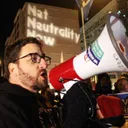
With your support, all these groups can keep fighting back.
A nation of millions vs. Flock. Friend-of-the-newsletter Evan Greer of Fight for the Future published an excellent Op-Ed in The New York Times last week on the growing public resistance to Flock camera and AI surveillance. “Corporate lobbyists and spokespeople want us to believe that an automated surveillance dystopia is not just desirable, it’s inevitable,” she writes. “The neighbors coming together to keep Flock out of their towns are proving them wrong. And they’re teaching us that grassroots organizing is the key to a future where people control technology, not the other way around.”
The kicker
“Today, billionaires yet again bribed, censored and bullied their way to the top. As a result, a billionaire media company closely allied with the president will soon own one of its closest rivals, including some of the nation’s critical news outlets. Saudi Arabia will co-own those outlets, too. Layoffs will follow. People from L.A. to Atlanta will lose their jobs, small businesses will lose their contracts, your cable bill and movie ticket will be even more expensive. Dissent against money and power will be even harder to find. This did not have to happen.” —Former FTC Commissioner Alvaro Bedoya