Looking Back, Looking Forward on New Jersey’s Groundbreaking Effort to Support Local News
While inspiring similar initiatives nationwide, New Jersey’s Civic Information Consortium faces a funding threat at home

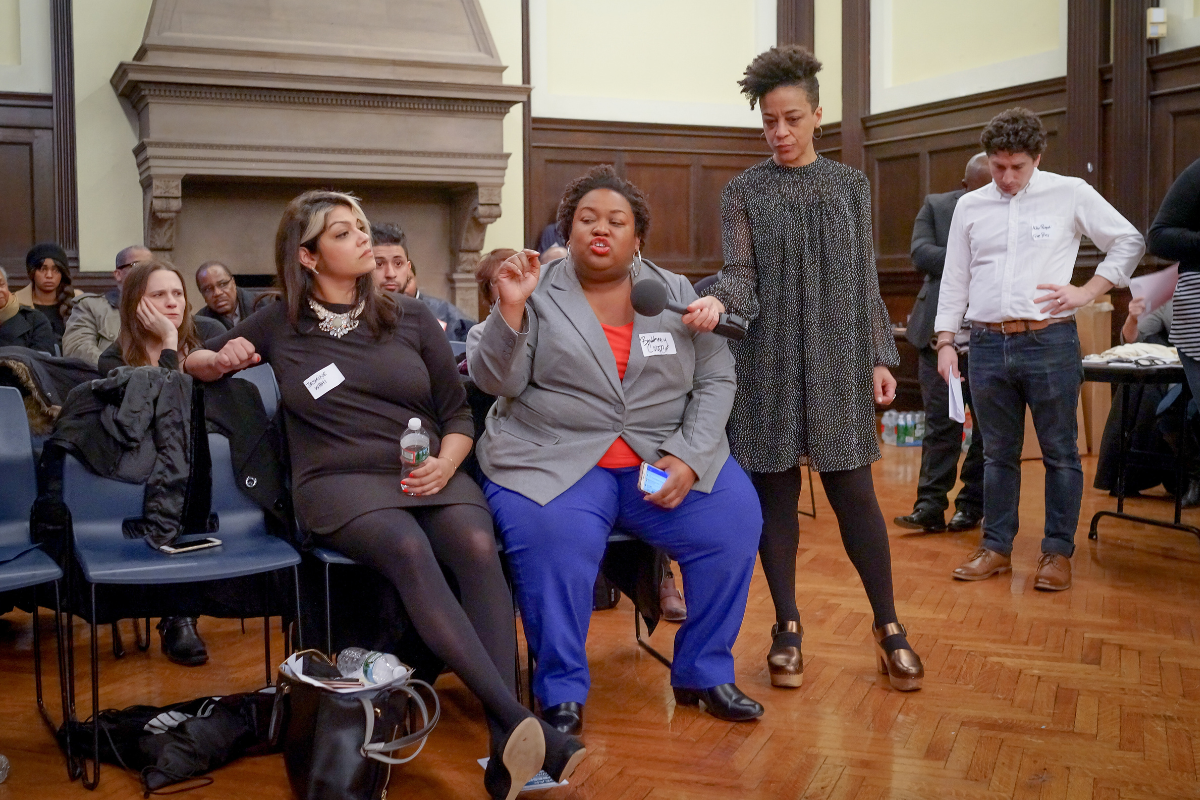
Many may not know it, but Feb. 4, 2016, is an important date in the history of local journalism — especially for the state of New Jersey.
On that day at Montclair State University, a diverse group of scholars, journalists, advocates and organizers came together to discuss the disappearance of local news — and test drive an idea for funding the sorts of journalism that serves communities that mainstream commercial outlets neglect.
New Jersey was the ideal setting for this discussion, but for all of the wrong reasons.
Since 2005, newspaper closures and layoffs have hollowed out local journalism across New Jersey. By 2025, the state had lost roughly 60 percent of its print publications — about 129 newspapers, more closures than any other state except Maryland, according to Northwestern University’s Local News Project. (My local newspaper, The Hudson Reporter, hung on until 2023, when it shut down due to mounting financial pressures.)
Elsewhere, pockets of the state were transforming into “news deserts” with few-to-no local outlets providing news and information to surrounding communities.
“Once upon a time, we had journalists covering every township council meeting. We had them at board-of-ed meetings. We had them covering things like zoning ordinances,” said New Jersey Citizen Action’s Jerome Montes, whose parents live in Lawrence Township.
“Now they’re coming to me and they’re saying, ‘Jerome, where do I get news about who to vote for? Where do I get news about what’s happening in my town? Where do I get news about local businesses and new restaurants?’ And the fact of the matter is, a lot of this has disappeared, and we need it back.”
To make matters worse, New Jersey’s larger newsrooms — such as Secaucus-based WWOR-TV — catered to New York City audiences based in the much larger media market just across the Hudson River. In the southern half of the state, larger commercial outlets tended to provide news and information focused on the more populous Philadelphia just across the Delaware.
A snowball’s chance
During that 2016 meeting, we discussed New Jersey’s emerging status as “ground zero” in the nation’s looming journalism crisis. And we hatched a possible solution: creating a public grantmaking entity that would support local outlets on the frontlines of New Jersey’s journalism crisis.
To bankroll the project, we were eyeing what would become a $100-million New Jersey windfall from the auction of state-controlled spectrum. On the block were licenses to airwaves that local public-television stations no longer needed to broadcast their programming, and which major wireless service providers coveted. Using a small portion of the proceeds — say $20 million — we could create a grantmaking body to produce the kinds of news and civic information that had gone missing, or that never existed in certain neglected communities.
I laid out an organizing plan that built on the concept my Free Press Action colleagues and state allies had sketched out. We would need state legislation to get a funding mechanism in place, and passing this kind of bill would require grassroots organizing. New Jerseyans needed to demonstrate their desire for a thriving local-news sector — and embolden their state lawmakers to help fund it.
Everyone in the room greeted the idea with enthusiasm — everyone, that is, except for a seasoned Trenton lobbyist who later informed me that our “little plan” didn't have “a snowball’s chance in hell.”
We knew better.
Creating the consortium, filling news gaps
We began by organizing 10 local listening sessions across the state. From Morristown to Atlantic City, people told us about the critical role local reporting plays in informing voters, exposing local corruption and engaging often-overlooked communities in civic affairs.
“I live in a news desert that became a news desert because of layoffs and cutbacks in coverage,” one participant said. “We actually have a contested local election in my township, for the first time in a while, but the only place I can get any information is on Facebook and what I read there I don’t trust.”
We gathered public feedback and formulated a legislative response. We built a diverse statewide coalition and encouraged thousands of New Jersey residents to call on their local lawmakers to take action. We identified allies in the New Jersey General Assembly and Senate.
By 2018, we had a draft legislative vehicle to create the Civic Information Consortium, a first-of-its-kind nonprofit with the mission of strengthening local-news coverage and boosting civic engagement in communities across the state. And we passed a bipartisan bill authorizing an initial budget outlay of $5 million. Yes, it was smaller than the $20 million we had envisioned, but such are the vagaries of Trenton sausage making, and at least we had a foot in the door.
Since its inception, the consortium has awarded more than $12 million to support civic-information initiatives across New Jersey, funding approximately 50 grantees and 220 journalism jobs.
“The support of the consortium has … allowed us to grow and expand coverage, and provide coverage to news deserts and areas that traditionally are uncovered,” said Penda Howell, cofounder of New Jersey Urban News, which is based in Newark with beat reporters on the ground in Camden, Jersey City and Patterson.
“We fill those spaces and those gaps that those traditional news outlets deserted when they went out of business,” Howell said. “And so we’re on the ground doing that reporting. Meeting members in the community where they are, hosting town-hall meetings in the community with community members.”
“Without the [consortium] we would not exist,” said Deborah Howlett, editor of NJ State House News Service, another consortium grantee. “We fill the need left when the Associated Press bugged out of the statehouse. Our goal is to cover what’s going on and distribute that content to our news-media partners across the state — so local, mostly nonprofit independent news media who otherwise don’t have the capacity to send somebody to Trenton to cover bills or other things that are going on that are important to their readers.”
A model for other states to follow
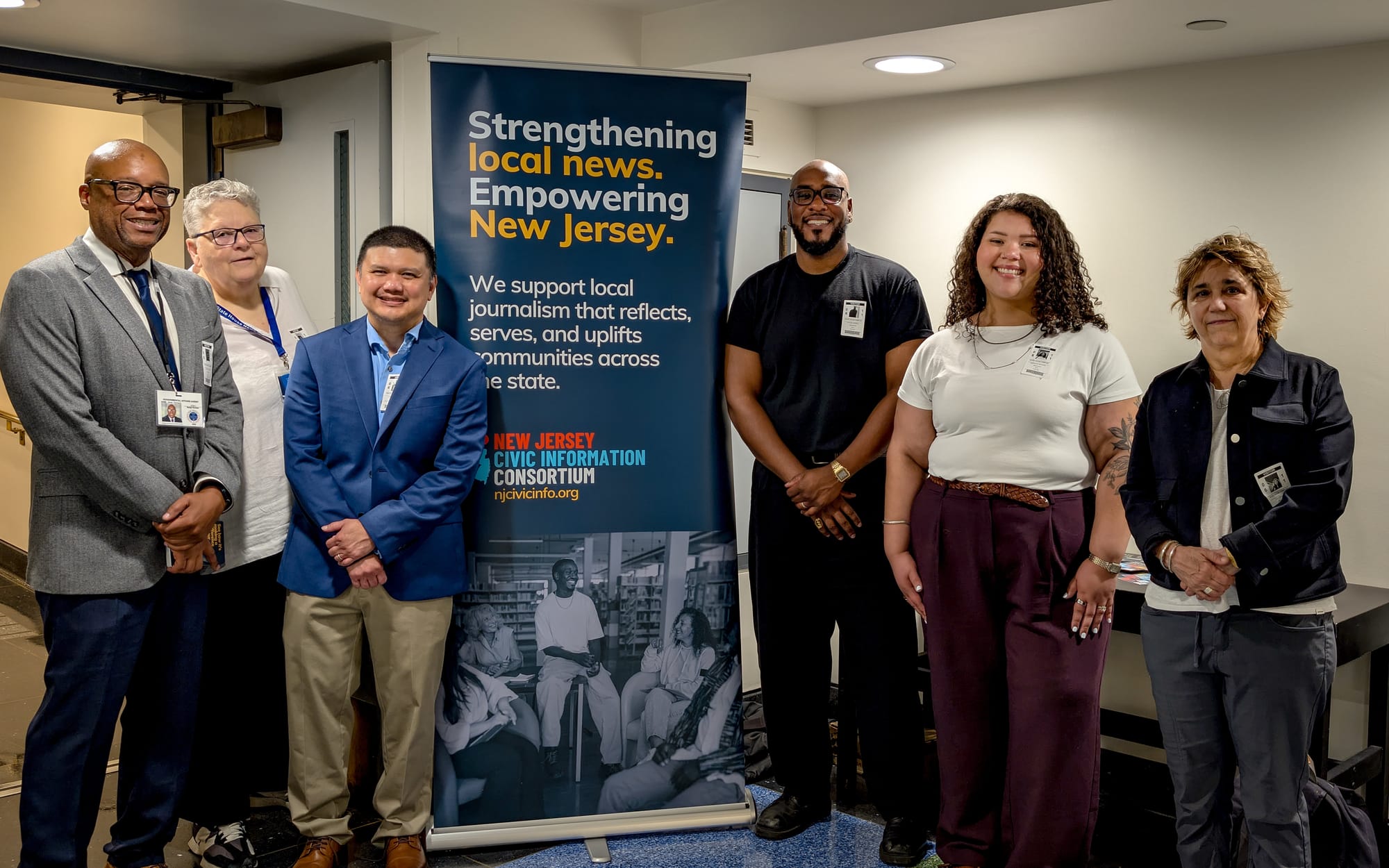
Earlier this month, I joined Montes, Howell, Howlett and members of the Civic Information Consortium to lobby Trenton lawmakers to continue supporting this innovative new program. On the same day, we delivered to lawmakers a letter signed by 95 local-media organizations, community leaders and advocates calling state-level support for local news ”critical to ensure the safety, wellbeing, and empowerment of New Jerseyans.”

The consortium has garnered praise from lawmakers in other states seeking a sound, state-level approach to funding local news. Similar initiatives are in varied phases of development and implementation in California, Pennsylvania and Wisconsin.
The civic-information-consortium model is taking root and spreading. What’s missing, though, is support for the program that started it all. Gov. Mikie Sherrill excluded funding for the New Jersey consortium from her initial 2027 budget proposal. We’re scrambling between now and June 30 — when Trenton’s budgeting session ends — to put at least $2.5 million of that back in place.
That boils down to about $1.25 per state resident, writes Nicole Rodriguez, president of New Jersey Policy Perspective, a nonpartisan think tank advancing economic, racial and social justice through evidence-based research and policy advocacy. “This is among the least expensive investments the state makes in civic life.”
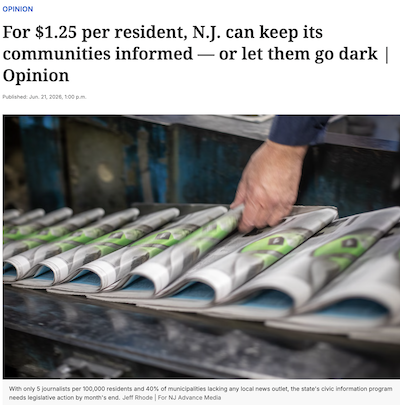
New Jersey’s news ecosystem still rests on unstable ground as news deserts persist across outlying counties (see Hunterdon, Salem and Warren), and underserved immigrant communities (see those in Elizabeth and Camden), where lower household incomes and ethnic demographics influence the availability of available local-news coverage. These vulnerable areas can ill afford to suffer any further losses to their local information infrastructure.
“It’s safe to say that that’s really essential money for local-news organizations across the state, and one of the reasons that we exist is to help serve those organizations,” said Howlett. People can help by contacting their legislators in Trenton to let them know “how important [the consortium] is for them to have access to information.”
There’s a bill to restore the funding to $2.5 million and another bill that would lift the appropriation to $5 million, Howlett added. “We think that’s barely enough.”
Indeed. According to an April Rutgers-Eagleton Poll of New Jersey residents, large majorities of both state Democrats and Republicans support a trustworthy and robust local-news ecosystem and would like to receive more news about their communities.
By continuing to fund the consortium’s groundbreaking work, New Jersey lawmakers can support a historic initiative 10 years in the making, and have a positive impact on the civic lives of everyday New Jerseyans. Let’s keep a good thing going.
Open tabs
The Minneapolis 15. The Philly Inquirer's Will Bunch writes that the federal conspiracy case against anti-ICE activists in Minnesota — the Minneapolis 15 — is a big deal, and part of the Trump administration’s plan to “silence us all.”
 Will Bunch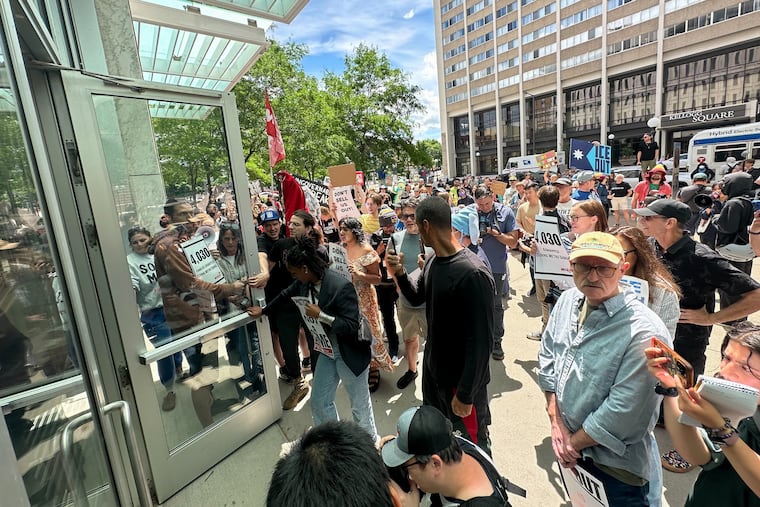
Another journalist death. One more in the growing and grim toll of journalist deaths in Gaza: Al Jazeera cameraman Ahmed Wishah was killed in an Israeli strike on a refugee camp. That raises the region’s journalist-death toll to more than 220 since the conflict began in 2023.
 Priyanka Shankar and Mohammad Mansour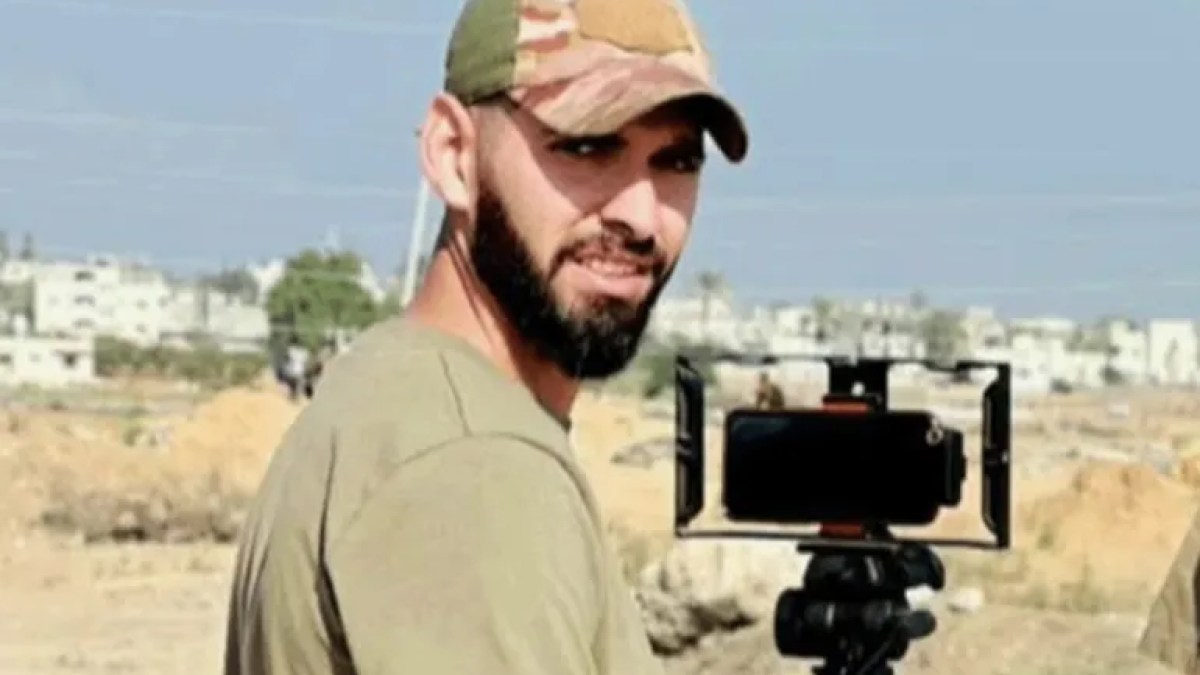
Free-speech absolutist™ Elon Musk is at it again. On Monday, the newly minted trillionaire threatened to sue Rep. Ro Khanna into silence after he accused Musk of “possibly” sentencing 4.5 million children to death by cutting funding to the U.S. Agency for International Development.
 Ariana Baio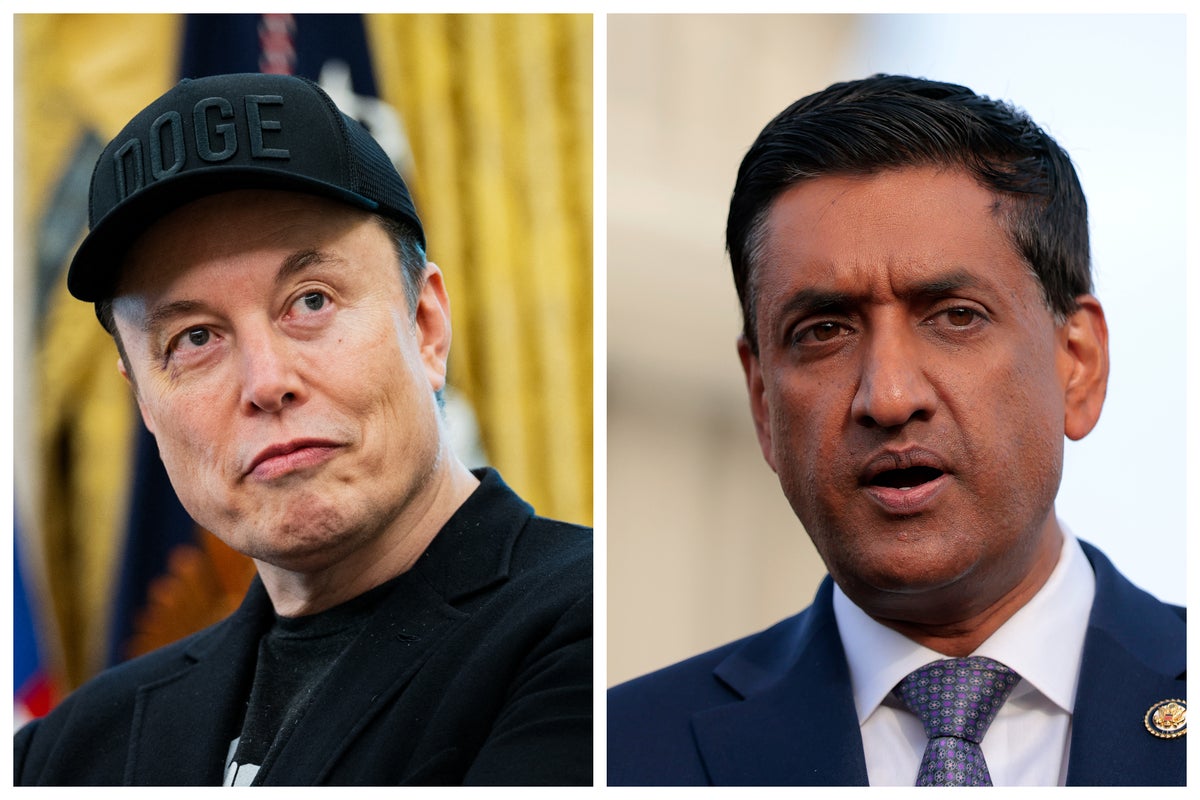
Teamwork
SOS webinar. A recent webinar featured advocates engaged at the forefront of the various battles for our rights to privacy and dissent. The event was part of the Solidarity Over Surveillance campaign, a multistate effort that Free Press and the Disinfo Defense League organized. Check out Raelyn Roberson’s blog post to learn more about the risks and threats facing communities at a time of AI-powered surveillance.
 Raelyn Roberson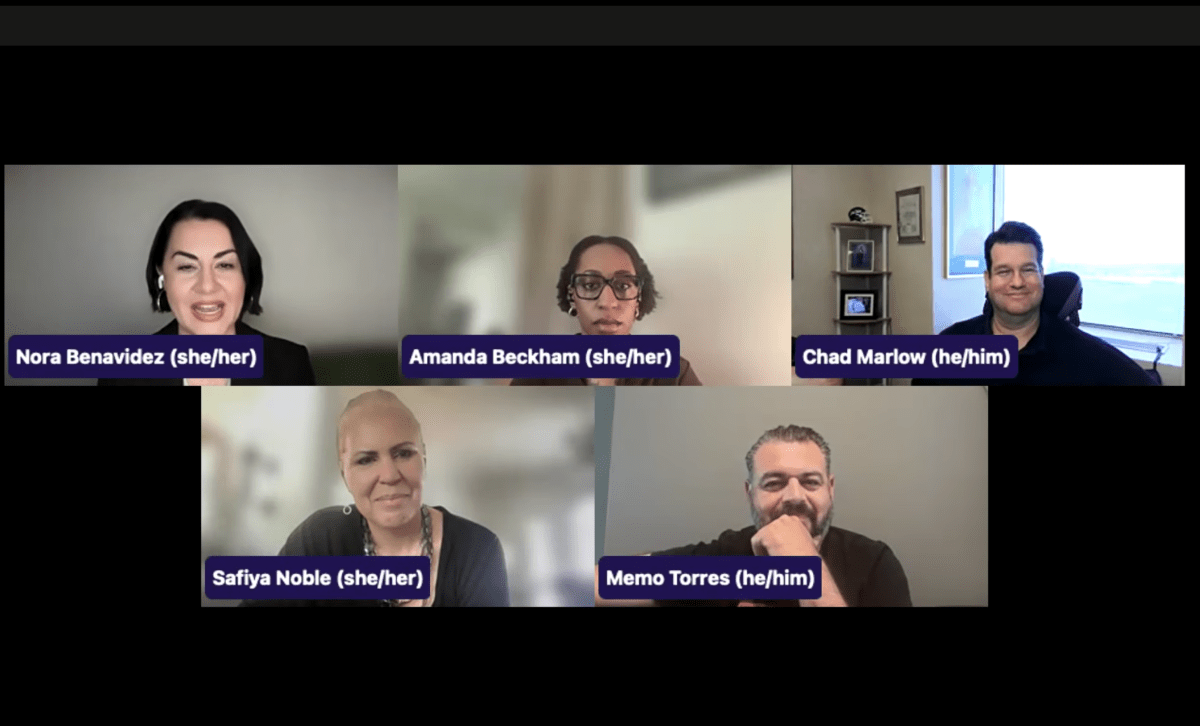
The kicker
“Eliminating funding would mean stepping back from the national leadership role New Jersey worked so hard to build, at a time when reliable, local information is more essential than ever for public safety, education, elections, and community life.” —Lisa Sahulka, executive director of the New Jersey Civic Information Consortium
About the author
Timothy Karr is the senior director of strategy and communications at Free Press. He’s worked as a photojournalist, foreign correspondent and editor for major news outlets. His commentary on the media has appeared in dozens of magazines and newspapers worldwide. Follow him on Bluesky.