There Is News You Can Trust
5 bright spots in the movement to grow civic media

With trust in American mass media now at 33 percent — after peaking at 72 percent 50 years ago — it would be easy to conclude that news and information have no viable future in this country.
But don’t tell that to the outlets doing the work and building trust one community at a time. They are not part of a dominant media system that favors consolidation and profit over the public good. These organizations are demonstrating what just and equitable media can become.
A new Free Press report, News We Trust: Bright Spots in the Movement to Grow Civic Media, profiles five of these outlets and challenges the idea that journalism can operate only under for-profit models, within traditional newsrooms and at a distance from the communities they serve.

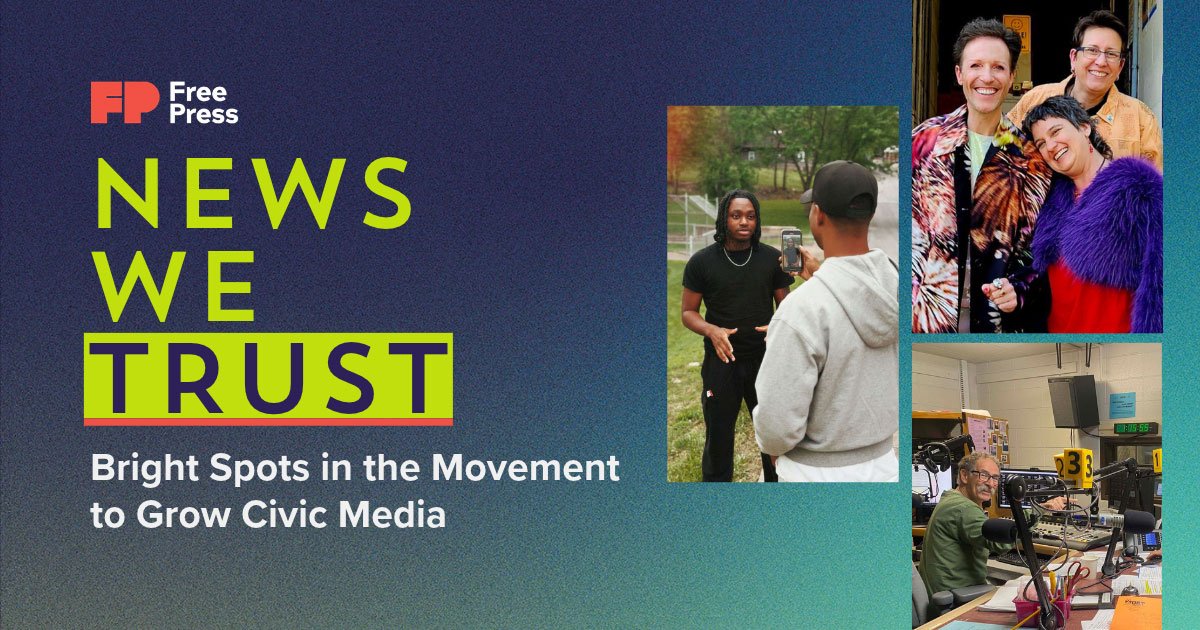
Co-authored by Vanessa Maria Graber and Qing Saville, the report draws on in-depth interviews with the following outlets and presents case studies that highlight this critical work.
- CivicLex: A Lexington, Kentucky, civic news and education nonprofit whose recommendations led the city to revise its public-comment process.
- The Kansas City Defender: A Black-led outlet in Kansas City, Missouri, rooted in the tradition of the radical Black press.
- The Listening Post Collective: A national program that helps communities map their information needs and launch their own outlets.
- The Philadelphia Hall Monitor: A worker-owned news co-operative covering City Hall for a highly engaged audience. (At which, full disclosure, Graber is a co-op owner and reporter.)
- WORT-FM: A volunteer-powered community radio in Madison, Wisconsin, since 1975.
The report found that these five organizations serve their communities in ways that go beyond journalism — from civic workshops to mutual aid. They earn trust through listening and relationship-building, filling information gaps that other outlets can’t. They generally work outside traditional journalism structures, which can make it harder for them to secure funding.
All these organizations, as well as countless others, form part of a growing movement to reimagine and reinvent local news.
To mark the report’s launch, I spoke with the co-authors. Graber is Free Press’ senior director of journalism and media education. Saville is Free Press’ civic media organizing manager.
This conversation was edited for length and clarity.
Julio Ricardo Varela: Why was it important to release this report?
Vanessa Maria Graber: We wanted to profile the newsrooms and community organizations that are doing things right. In our organizing work, and also in our policymaking, we often have a strong critique of how mainstream or corporate media has been failing us. We also bring up the impacts of racism’s legacy on the communities that have been excluded and underrepresented.
All of that is true, but the other side of that is all the amazing people we’ve met along the way, organizing in states like New Jersey, Pennsylvania, North Carolina and all over the country. They are doing exactly the kinds of things we feel represent our values and actually serve communities.
I think it was important to demonstrate that not all media or people who are providing news and information are bad actors. There are many great people who care and should be supported by some of the public-policy solutions we advocate for.
We wanted to show the other side of the broader media narrative: that there is news you can trust.
Qing Saville: We started this project in 2025. The political context matters because it was the first year of Trump’s second term and we were seeing devastating ICE raids, chilling of free speech and serious threats to democracy. We initially wanted to see how this was impacting these organizations, but we ended up learning more about bright spots in their work rather than bad news.
Organizations that are community-rooted in their work are knitting the social fabric. That was important to showcase. We have to pay attention to them.
JRV: What was one surprising thing you learned from this work?
VMG: What makes these organizations unique and interesting to study versus a traditional newsroom is that they go beyond reporting the news and providing information. They do a lot of activities such as mutual aid, workshops and community engagement. They spend a lot of effort building relationships in the community, not just to build a source list, but to build a movement. Everybody we talked to doesn’t do this just to inform people. They want to improve their communities and mobilize people to participate in civic processes to make them better.
We normally don’t hear that same motivation from journalists in traditional newsrooms.
QS: I’ve seen more than 10 years of evidence that local news that begins with a community's needs — rather than starting with a story idea — creates a stronger information product. It’s because the people producing it often see themselves as part of the community. That’s so important. It creates a fundamentally different type of offering that’s much more effective at connecting and informing people.
VMG: And they feel more accountable to the community. Which is why they’re doing all of these things to build trust, to understand what the community needs, and to be fair and accurate in their representation. They’re not accountable to shareholders or advertisers. They’re accountable to their friends and neighbors.
JRV: Why do you think this civic-media model is so misunderstood? What can we learn from this type of model that a more traditional model may not achieve?
QS: The civic-media model is misunderstood only by those who believe there’s one way to do and fund journalism — an approach that’s still based on the ideas of “journalist” as separate from community and of business and “reach” metrics being the main markers of success or failure. Traditional journalism models don’t often consider or track the impact of their reporting practices, which have been historically extractive and inequitable, or the impact of their outputs on people that traditional journalism wasn’t created for — Black and brown folks, immigrants, communities of color, queer folks, economically disenfranchised folks, rural folks.
The civic-media approach and ethos represent a fundamental shift from journalism as a product sold to consumers to journalism as a public good for communities. It shows what's possible for our futures and our shared civic health when communities are at the center of it all.
VMG: Imagine what we would do if we got public funding for these organizations, if we could convince funders to widen their scope of journalism grantees, if we introduced community members to different kinds of journalism.
JRV: What do you want this report to achieve?
QS: It will serve as an organizing tool for our work in the public-policy space. I also hope that funders and policymakers can refer to our work, be inspired by these examples and use our recommendations to direct resources, to direct the money and fund these places.
VMG: This isn’t just about journalism. It’s also a movement for community empowerment. When we are more informed, we trust these messengers and we’re mobilized to action. Ultimately, we can gain wins for our communities.
About the author
Julio Ricardo Varela is the senior producer and strategist at Free Press. He is also a working journalist, columnist and nonprofit-media leader. He is a massive Red Sox, Knicks and Arsenal fan (what a combo). Follow him on Bluesky.
Action news
Senate pressure. On Wednesday, Senate Commerce Committee Republicans voted to advance Danielle Thumann Severs’ FCC nomination to the Senate floor, despite a Democratic boycott of the committee vote. The vote came a day after New Mexico Sen. Ben Ray Luján presented evidence that Thumann Severs had misled the committee with false testimony.
“As this moves to a full Senate vote, Free Press Action urges senators to vote no on Danielle Thumann Severs,” Free Press Action Co-CEO Jessica J. González said.


For a detailed recap of this week’s developments, check out Mike Ludwig’s story at Truthout.
 Mike Ludwig
Teamwork
Warrantless spying. Over at The American Prospect, there’s a bipartisan push to renew Section 702 of the Foreign Intelligence Surveillance Act (FISA) by attaching it to the National Defense Authorization Act (NDAA) before the lame-duck session ends.
The story quotes Amanda Beckham, Free Press Action’s government relations director, who said the following: “Using must-pass legislation like the NDAA to yet again try to force a clean reauthorization of this powerful tool is a desperate move to advance a warrantless surveillance agenda that has been rejected by the majority of Americans.”
 James Baratta
The kicker
“Whose opinion and who are we actually accountable to? To professional national-journalism people — or to the people in our community?” —Ryan A. Sorrell, founder and executive editor of The Kansas City Defender