Why Independent Filmmakers Are Fighting the WarnerMount Merger
A Q&A with Jax DeLuca About Why Future Film Coalition Wants to #BlockTheMerger

Warner Bros. Discovery shareholders voted in favor of the deal with Paramount Skydance on Thursday, taking another step toward finalizing a massive merger that would drastically alter the corporate media and entertainment landscape.
Like many others following the story — including all of us at Pressing Issues — Jax DeLuca has been watching closely.
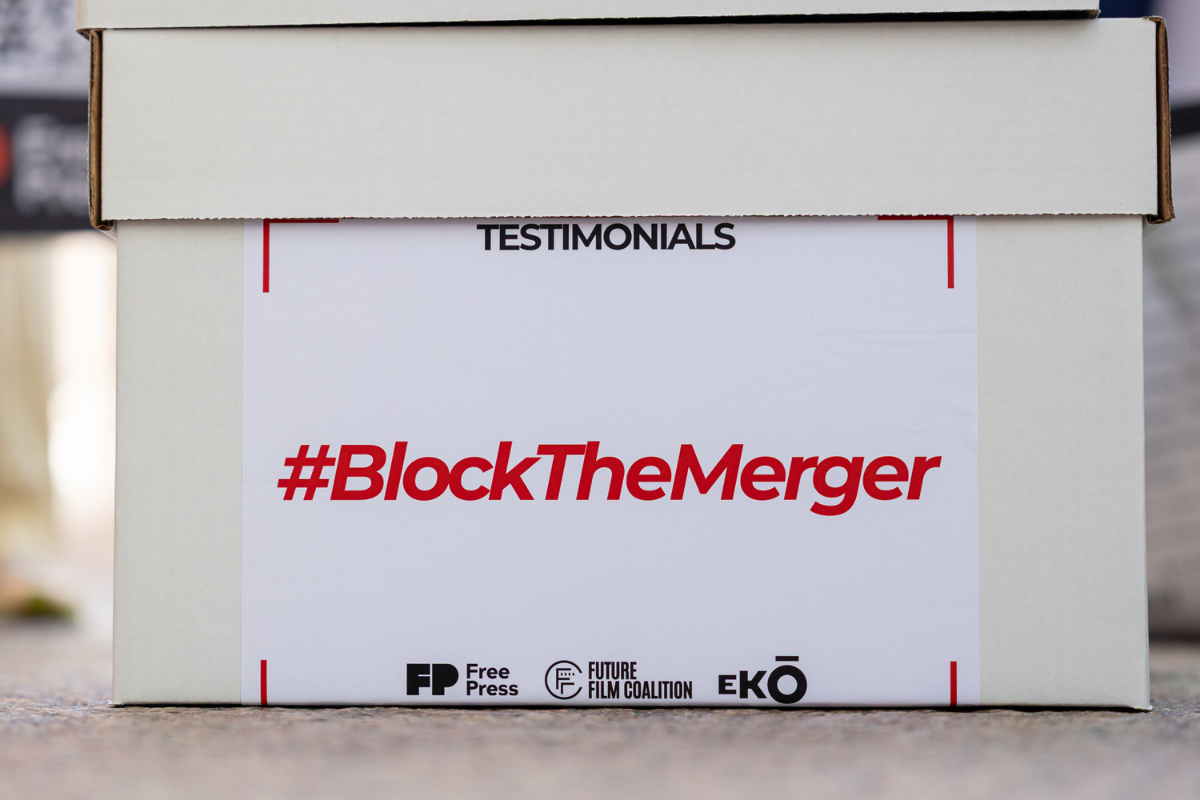
DeLuca is the executive director of Future Film Coalition (FFC), an advocacy organization that unites independent filmmakers, distributors, exhibitors and other workers across the film and media supply chain. FFC’s #BlockTheMerger campaign has been collecting testimonials from people across the film industry to build an evidentiary record for regulators and policymakers about this potential merger.


I spoke with DeLuca about the shareholders’ vote, what these #BlockTheMerger stories are revealing and why this fight extends far beyond Hollywood.
This conversation has been edited for length and clarity.
Ruth Livier: The Warner Bros. shareholder meeting was yesterday. Do you think corporate media is focusing enough on the potential harms of this merger?
Jax DeLuca: No, I still don’t. When you start reading some of the comments from the amazing open letter that went out last week, you have one type of commenter who doesn’t feel bad for Hollywood at all, but there are also many assumptions about Hollywood and who actually powers it.
There are movements like Stay in LA involved, and if people go on that website and look at what’s happening to the people working in this industry, they’d see it’s not a magical place where money gets thrown into the air. In reality, what’s been happening here is very similar to what’s happened with the internet — industries becoming extractive.
RL: Even if you’re not in the entertainment industry, why should you care about this potential merger?
JD: Because if you’re not paying attention to it now, in 10 years you’re definitely not going to be paying attention to it. The way that your perspectives and your worldview might be shaped will be by things that you did not have control over — entities would have shaped them for you. Being aware of what’s happening here, not just this year but for years, is really important. It’s really interesting how invisible many of these merger discussions are.
I kind of want to go back to a conversation I had with my dad a few months ago about this, and he asked, “Well, why should I care?” He said, I’ve never heard of Skydance, I don’t even know who they are or what they do — so no big deal, that doesn’t affect me.
And I said, well, do you know that there’s HBO, CNN, all these different things that are packaged in with these mergers? It’s just so opaque when it’s brought up in most news outlets — and probably due to the fact that they want it to be pretty cloaked. If more people had the curiosity to unpack what’s happening for themselves, I think they might come to the same conclusions.
RL: Can you tell me what the #BlockTheMerger campaign is, and why you launched it?
JD: We thought that was really important because our members operate across the full film and media supply chain, and they’re predominantly small businesses and independent companies. They’re also embedded in very local economies and communities. We wanted to start collecting those stories so we had evidence when this merger was under review — so that when regulators needed information, we would be able to say, here are the different ways that this field, in particular, has been impacted by media consolidation. Not just from the merger currently under review, but also from all prior years and various mergers. From there, we can gain enough evidence to show the specific harms to the independent film ecosystem.
RL: Based on what you’ve found from these stories, who benefits from this merger, and who does it harm?
JD: I don’t want to repeat everything that’s been stated in the media over the past few weeks about the obvious beneficiaries, but one of the things we’re collecting a lot of evidence on is that there is an increasingly unfair loss of negotiating power for those working in the industry. These are people who are good at their jobs. Many people in Hollywood are not working right now.
There’s a very dangerous thing that happens when turning on the television and being entertained is the only way you use your digital media. A good portion of my life has been about media literacy — helping people really understand who shapes the media, whose stories might not be told or represented, where it’s going and who it could reach. When you have a lot of gaps in that, people start forming perspectives about how the world works that might not be true. And that affects how people engage with each other as community members, and maybe also how they think about the government and the entities that are supposed to support us as humans.
When one family — like the Ellisons — holds so much power over much of the media people consume day to day, it would be very, very easy for that to continue to have damaging effects. So it’s a little different than the financial component, which is a huge element — there will be layoffs, people who don’t have access to work, and people who will be forced to take contracts they wouldn’t normally take at low rates because they have no negotiating power. On top of that financial aspect, you have this whole other world-shaping, perspective-shaping component that we’re already seeing.
I don’t see much benefit from a merger, because it feels like a tipping point where things will just start becoming out of control. And when we put this alongside what was happening with Nexstar-Tegna, and the way that the FCC had waived the local media-ownership caps — which is just absurd — whenever a local station goes through this consolidation process, sometimes they’re forced to dump their archives or delete them entirely. All of a sudden, you have no access and no record of certain things happening in communities that might have only been captured locally. We’re continuing to go toward a place where other people are shaping those perspectives for us. That’s dangerous.
RL: Who is responding to the story collection, and why?
JD: We’re getting responses from independent producers, directors, writers, people who work in the independent distribution landscape. We have people who work in exhibition — and that includes people representing art-house theaters and your local non-chain Main Street theaters, which are probably critical to their communities because that might be the only place where people have access to films they wouldn’t otherwise see.
We’ve even received stories from film-festival attendees — we’re seeing the frustration of how hard it is to find films in theaters because they’re just not coming in. Theaters talk a lot about this in terms of their agreements and theatrical windows. This is more of an issue for single-screen and smaller multi-screen theaters. When some of these films do make it onto a major streaming service, they’re often buried — someone would have to know to look for them. It won't be a default feature. That’s when we start moving into the territory of algorithmic bias, because streamers will prioritize their own content over independent content that they may have acquired for a very cheap price. There is a narrowing of cultural visibility, which makes it harder for the average person to encounter independent films.
People working on the production side are in a market where consolidation has already reduced the number of viable buyers for non-franchise films. Not Lord of the Rings, not Harry Potter, not Game of Thrones, not the larger Marvel properties. Because of that, when new projects and new ideas and new types of stories come up, there’s less ability for financiers to take a risk on that story, because they’re not sure if it will actually make money at the end of the pipeline. And the people actually producing the work are often forced to accept weaker terms and lower rates. And even if one of these larger entities does commission the work, they’re starting to cap rates and fees because people are hungry for work right now.
Another thing that’s come up is the long-term loss of IP ownership. If someone is selling or licensing their work and a larger streaming entity acquires it, they are unable to maintain their IP rights. This is why people sometimes call Netflix the ‘Netflix graveyard.’ They might buy a film for $10,000 or $20,000, and a filmmaker might be relieved to finally have somewhere to drive audiences to — even though it’s nowhere near the cost of making the film — but they’ve lost control of their work.
RL: Any calls to action or ways the public can help support these efforts?
JD: What’s really helpful is for people to continue submitting stories. We want to be ready when people ask for this information, and we’re already using it to educate policymakers and regulators.
That information is really helpful because it’s also evergreen — we know this isn’t the last merger we’ll have to push back against. Collecting a longer-term arc of data on how media consolidation has impacted anyone — whether you’re an audience member, someone who works in the industry, or a theater owner — all of that is really useful.
It’s also really hard to block a merger or help people understand the impacts if we don’t have the evidence. And I know right now it’s very scary for people to come forward with that. At BlockTheMerger.com, you can submit anonymously and confidentially in story form. You can also submit without any identifying information in your story. Our goal is really to articulate those harms. If we don’t have that data collected, it would be really hard for the independent film field to talk about how it’s been impacted.
About the author
Ruth Livier, Ph.D., is a campaign manager at Free Press. Ruth has more than 20 years’ experience in the entertainment industry, which drives her commitment to fight for media equity. Follow Ruth on Bluesky.
Action News
Compiled by Pressing Issues editors
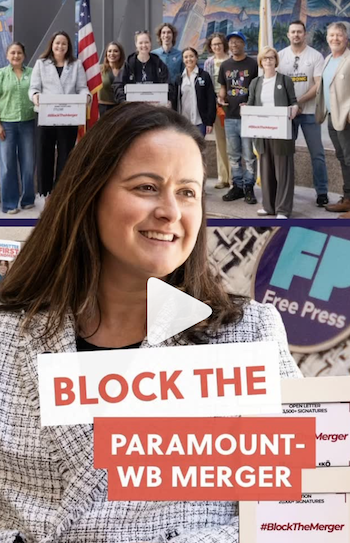
Special delivery! It was a busy week for anti-merger activists. On Wednesday, Free Press took its fight to the California Attorney General’s office and delivered 171,000 signatures from everyday people against the deal, urging the state to step up and protect consumers from this merger madness. Free Press Co-CEO Jessica J. González shares more in this video about the action.
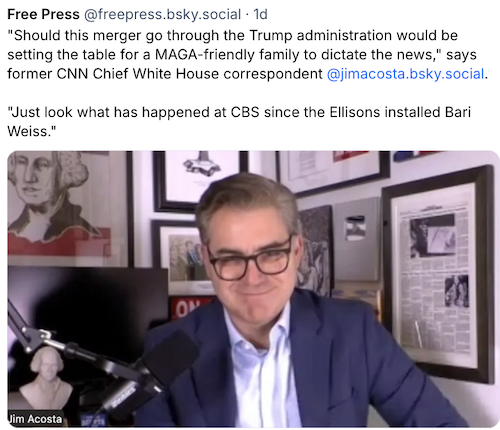
Later on Wednesday, Free Press and the American Economic Liberties Project hosted a press call with former FTC Commissioner Alvaro Bedoya, Writers Guild of America West President Michele Mulroney, former CNN Chief White House Correspondent Jim Acosta and Oscar-winning director David Borenstein.
“Should this merger go through, the Trump administration would be setting the table for a MAGA-friendly family to dictate the news,” Acosta said. “Just look at what has happened at CBS since the Ellisons installed Bari Weiss.”
Then on Thursday morning, New Yorkers turned out to protest at the shareholder vote — alongside City Comptroller Brad Lander, Public Advocate Jumaane Williams, Rep. Dan Goldman, and Borenstein, among others. The protest even got covered by CBS!
CBS New York
And Thursday night in D.C., Public Citizen, Free Press and allies rallied across the street from what used to be the U.S. Institute for Peace. Inside, Paramount was feting Donald Trump and other administration officials at what protesters nicknamed “The Corruption Gala.” Pressing Issues’ own Craig Aaron spoke to the crowd alongside Reps. Becca Balint and Jamie Raskin, Ambassador Norm Eisen of Democracy Defenders, Bedoya and others.
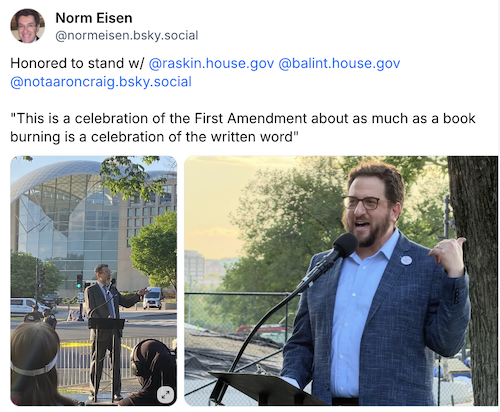
“I’ll say this for Paramount: It doesn’t take an investigative reporter to expose their corruption,” Aaron told the crowd, before leading a “Block the Merger!” chant. “They’re putting it on full display for all of us to see.”
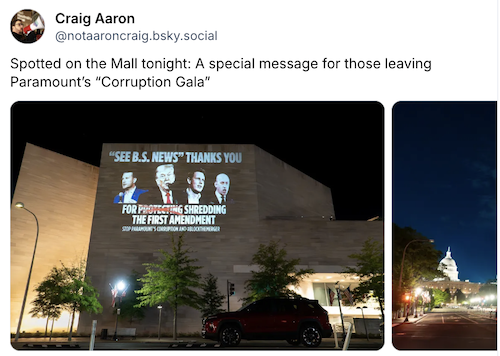
Later that night, a projection was seen on the Mall with a message for those departing the gala.
The kicker
“This merger is bad for New Yorkers three times over. Thousands of jobs at risk here in the city. Streaming bills going up as competition disappears. And two of America’s most powerful media companies under one roof, deciding what you watch and what you hear. Today, as Warner Bros. and Paramount shareholders vote, New York City is on record: this merger should be stopped.” —New York City Mayor Zohran Kwame Mamdani, April 23