How Hungary’s Independent Media Helped Defeat Orbán
The country’s independent journalists gave U.S. media a successful blueprint for overcoming authoritarian control


The hangover from last weekend’s celebrations in Hungary still lingers for many as the country settles into a post-Orbán reality with a renewed chance to build a more just and democratic political system.
And while many worldwide hope that Budapest’s joy is contagious — emboldening resistance to fascism in other democracies — hard work remains to uproot the legacy of Viktor Orbán’s brand of totalitarianism in Hungary, and in those countries whose right-wing leaders are following his lead.
One major reason Hungarian voters rejected Orbán with strong majorities is that people across the country had grown disgusted by his corruption — something they learned about because of the doggedness of independent investigative journalists who built their own news networks despite Orbán’s relentless efforts to bring the nation’s media to heel.
Their ultimate success deserves recognition, and their methods should provide a model for media in other countries seeking to beat back the threat of authoritarian rule.
‘Journalists didn’t give up’
Hungarians found a path out of dictatorship against major odds, including a leader who created the modern-day mold for strong-arming corporate media to do his bidding.
In the immediate aftermath of Orbán’s defeat, Princeton’s Kim Lane Scheppele, a sociology professor and Hungary expert, told the Contrarian how Orbán-friendly oligarchs took over Hungary’s media, and how independent journalists used the internet to build an alternative to evade this control.
“What happened there happened here,” she said, comparing Orbán’s heavy-handed measures with Trump’s capture of the U.S. administrative state and, through it, the media.
“When Orbán came to power, he fired all of the journalists from public broadcasting,” Scheppele said. “He was able to use his regulatory powers [to allow] oligarchs to swoop in and buy up the precarious media.... They just went in and used the economic power of their oligarchies to take over the media, and within a few years, they controlled virtually everything. And so there are about zero opposition TV stations, zero opposition radio stations and zero big circulation newspapers that are in the opposition’s hands.”
 Jennifer Rubin and Norman Eisen and Kim Lane Scheppele
“The journalists didn't give up,” Scheppele continued. “The TV journalists founded a YouTube channel, which was very hard for the government to shut down... I was getting all my news from watching this online YouTube channel called Partizan.”
The last of Hungary’s independent radio stations (like Klubrádió) moved to Web-based live streaming. Many independent newspapers went on the Internet as well (like Magyar Hang), Scheppele explained, while other independent journalists moved to neighboring countries and started their own websites (like Direkt36 and Telex). “They were able to use the internet to their advantage to maintain some semblance of democratic media.”
Following Orbán's roadmap
“Viktor Orbán was a model for President Trump’s media-bashing rise to power,” CNN’s Brian Stelter wrote in the aftermath of last Sunday’s vote.
Since returning to power in 2010, Orbán has decimated Hungary’s independent press while rewarding his wealthy political cronies with consolidated control over major outlets. “Orbán's allies captured privately owned outlets, interfered with news coverage, transformed public broadcasting into propaganda, and weaponized regulating bodies for partisan political gain,” Stelter wrote.
If that sounds familiar to media watchers in the United States, it’s because President Trump and his FCC Chairman Brendan Carr are closely following Orbán’s roadmap to media control.
Trump and Carr have repeatedly bullied major media outlets into providing favorable coverage to the White House. Their actions include leveraging regulatory powers over broadcast licenses, filing high-priced lawsuits, and issuing social-media rants that demean critical voices in the press. They have labeled an “enemy of the people” any outlet that doesn’t toe Trump’s hard line.
Those massive media companies that capitulated to the Trump administration include the likes of networks controlled by Paramount Skydance (CBS) and Disney (ABC), local broadcast subsidiaries owned and operated by Nexstar Media and Sinclair Broadcast Group and prominent daily newspapers owned by Jeff Bezos (The Washington Post) and Patrick Soon-Shiong (The Los Angeles Times).
As Free Press revealed in its Media Capitulation Index released last year, these companies — while privately owned — are not genuinely independent. Their deep entanglements with government interests, including their dependency on government contracts, merger approvals and other official favors, have compelled owners of these media companies to bend the knee to Trump’s White House and his FCC.
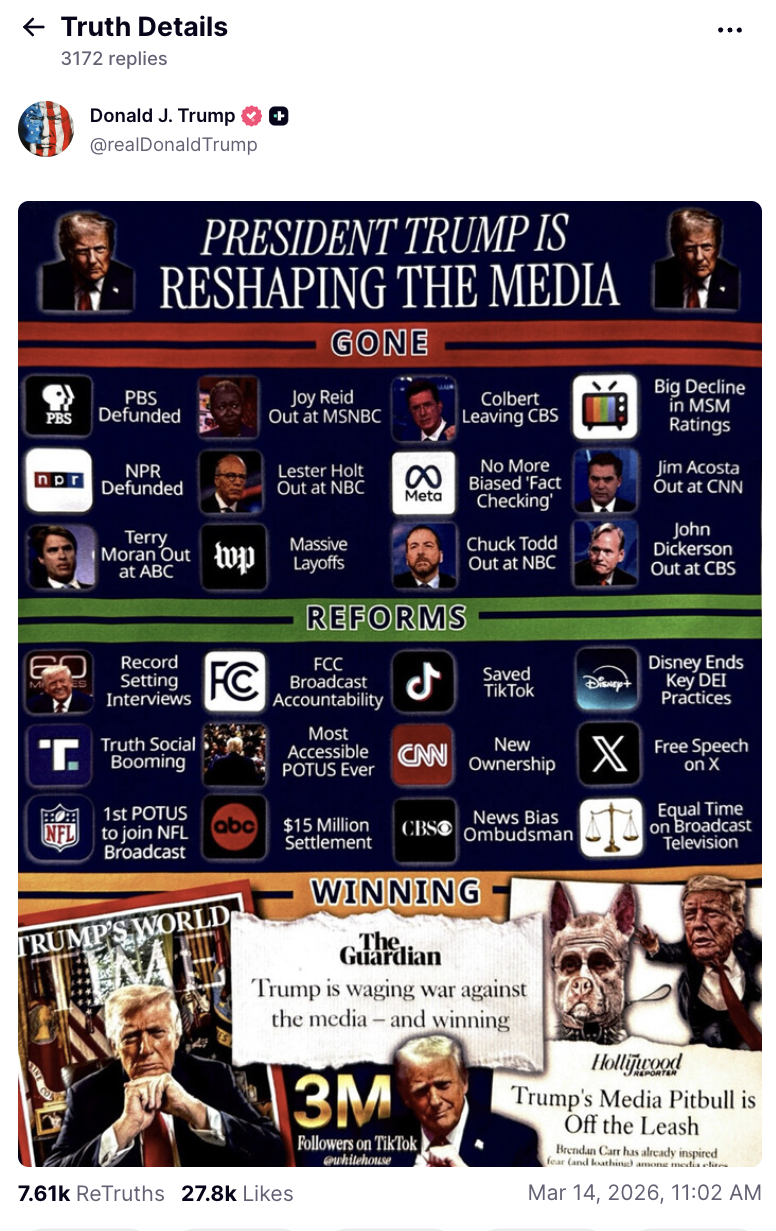
In a now-infamous Truth Social post, Trump even boasted about his ability to hack away at First Amendment protections to get the media to fall in line. In it, the president took credit for the firings of Stephen Colbert and several prominent journalists, the “massive layoffs” at The Washington Post and the defunding of public media, as well as “new ownership” of CNN. The crude design also depicts Carr as Trump’s snarling Chihuahua.
The democracy-giving oxygen of an independent press
Hungary’s lesson is that media capture happens more easily in countries where media power has been consolidated into the hands of the few.
In such a setting, media owners bend to political pressure not because they are ordered to, but because the path of least resistance and most profitability for oligarchs runs through compliance with government. “America has not lost its free press,” the European Council on Foreign Relations’ Chris Herrmann wrote in a comparative analysis of media threats in Hungary and the United States, “but the conditions that make independent journalism possible are being eroded.”
But all is far from lost.
Orbán’s crushing electoral defeat put to rest assumptions that there’s no future for a free and independent press in the face of illiberal, strongman politics. Providing a resilient ecosystem in which independent and local media can thrive is essential to winning the fight against 21st-century autocrats.
While it’s true that democratic political systems can be smothered without the oxygen of independent media, it’s also true that independent journalism is difficult for even the most ruthless dictators to eliminate.
But these outlets need constant care and feeding to survive.
In Hungary, people grew tired of Orbán’s rule and demanded change in overwhelming numbers. They learned of his persistent corruption from independent journalists, who refused to soften their coverage of the prime minister or normalize his most outrageous actions. If Orbán’s efforts to undermine a free press can be overcome, so can similar efforts elsewhere, including in the United States.
About the author
Timothy Karr is the senior director of strategy and communications at Free Press. He’s worked as a photojournalist, foreign correspondent and editor for major news outlets. His commentary on the media has appeared in dozens of magazines and newspapers worldwide. Follow him on Bluesky.
Teamwork
Compiled by Pressing Issues editors
They hope you’re not watching so they can watch you. In a vote held after two in the morning, the House of Representatives approved a two-week extension of Section 702 of the Foreign Intelligence Surveillance Act. But the real story here is the broad and bipartisan rejection of the long-term expansion of spying powers being pushed by Stephen Miller and President Trump’s congressional allies.
Free Press Action has been fighting to reform Section 702 for years because it has been abused to spy on journalists, protesters and even members of Congress. While congressional leaders tried to sneak through more spying in the dark of night, we teamed up with groups like Demand Progress, the ACLU, the Project on Government Oversight, the Center for Democracy and Technology, the Brennan Center and Asian Americans Advancing Justice to urge Congress to oppose an extension without reforms and reject fake compromises. Last night, they did — bringing together both Democrats and Republicans who understand that no administration should have this unchecked power.
There will be a lot of arm-twisting and another vote soon, so there’s never been a better time to call your representative and make sure they’re standing up against mass surveillance and for your privacy.


It’s a billboard! It’s a plane! It’s super-activists fighting Big Media! On Wednesday, as Paramount Skydance was holding its “Upfront Week” to attract advertisers to CBS’ fall programming, Free Press sent out two billboard trucks — along with an airborne banner — to show sponsors how badly Paramount has damaged CBS’s independence and credibility and oppose the proposed $110 billion acquisition of Warner Bros. Discovery.
Timothy Karr
The kicker
“If you had only just read or watched the pro-government websites or outlets then you would have no idea about what’s going on in the country.” —Martón Kárpáti, the president of the board of Telex, on the defeat of Orbán and the importance of free media