New Jersey’s Big Chance to Revive Local Media
Journalism in the Garden State is at a crossroads. Choosing the right path could be transformative.

For the past 10 years in my role with Free Press and Free Press Action, I have had the honor of listening to and speaking with residents in every corner of New Jersey — people from across the political spectrum, from various racial and ethnic backgrounds, in rural communities and urban centers.
They all say the same thing: They need more high-quality local news in their communities so they can navigate their daily lives and feel connected to their neighbors.
These firsthand accounts of how communities are hurting energized the grassroots campaign to create the New Jersey Civic Information Consortium (NJCIC) in 2018.
A bipartisan, independent nonprofit, the state created the consortium — in response to a multiyear campaign that Free Press Action led alongside local allies — to invest public funds in local news and community information.
 Christine Schmidt
Since it began grantmaking in 2020, NJCIC has distributed $12 million to community-centered projects and is helping build a sustainable, community-centered local-news system across the state.
In creating the NJCIC, New Jersey’s bold leadership positioned the state as a national model for innovation in public media. Right now, New Jersey is facing an even bigger opportunity that could reshape the state’s media landscape for generations to come — if legislators and Gov. Mikie Sherrill seize the moment.
New Jersey shows up for local news
New Jersey is in the process of selecting a new television-broadcast partner to operate its public-media system and deliver freely accessible, public-interest programming over the state-owned airwaves. For years, operators in New York and Philadelphia have managed New Jersey’s public media. The end of those current contracts — combined with disastrous federal cuts — have created a chance to bring things back home and build for the future.
At the same time, Gov. Sherrill’s initial proposed budget didn’t include any funds for the NJCIC this year despite the program’s immense popularity among lawmakers.
With COVID-relief funds running out and fewer federal dollars going to states, New Jersey lawmakers are debating what to prioritize. Many worthy projects in mental health, childcare and community-support services are under threat, along with the funds that support the NJCIC and public broadcasting.
Negotiations over what to add to the governor’s baseline budget happen every year. But what the state ultimately decides to do will have huge implications for local-media ownership, whom New Jersey media serve, and whether the state will continue investing in local news and informed communities.
What gives me hope is how New Jerseyans always show up to support local news: Many policymakers and journalists once dismissed the concept of the NJCIC as a long shot, but thousands of residents organized and rallied to pass the historic legislation to create the nonprofit.
 Mike Rispoli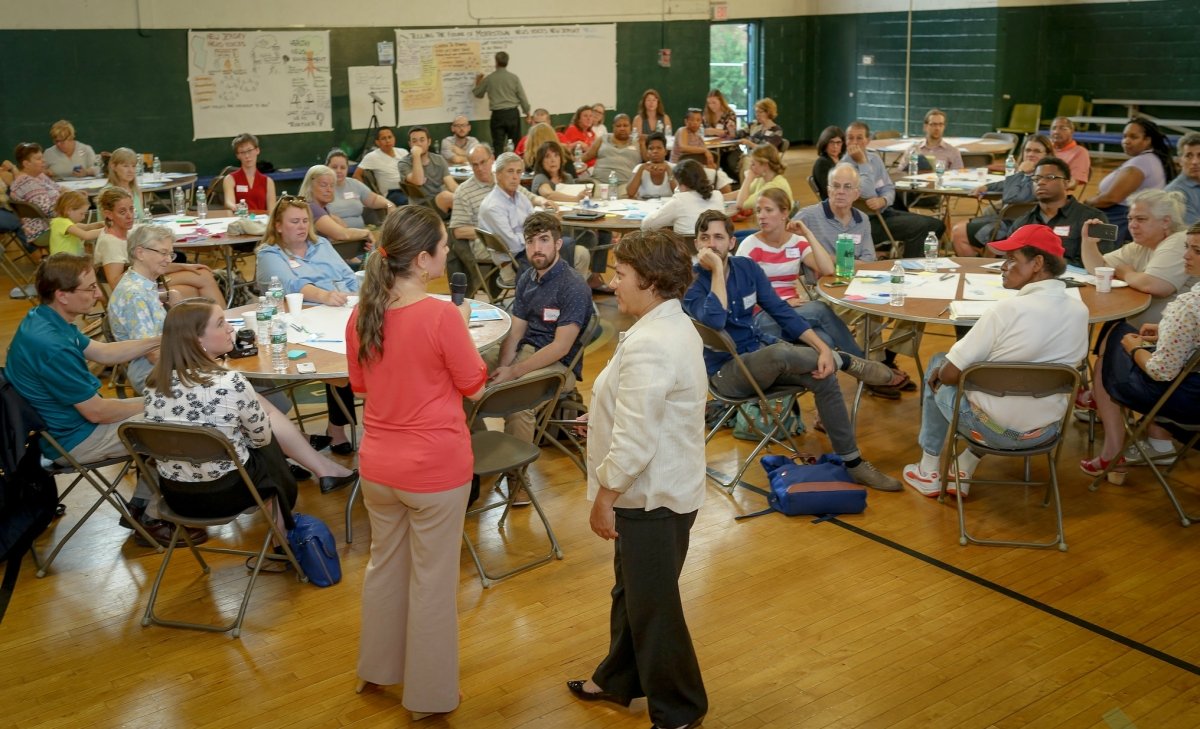
Over the years, thousands more people have spoken up about the importance of the NJCIC and helped restore its funding in other tight budget cycles. Supporters are mobilizing now to do it again.
This year there’s a unique opening to transform the media and the state’s future by bringing together the NJCIC and a revived state public media to better support media makers of all kinds all across the state. A new report the NJCIC commissioned suggests what’s possible.
A new vision for New Jersey’s media
Funding for the Corporation for Public Broadcasting has been eliminated at the national level, a devastating blow to an already woefully underfunded public-media system. In New Jersey — as in many places across the country — this has led to layoffs and station closures. As a result, countless residents are in the dark about what’s happening in their communities.
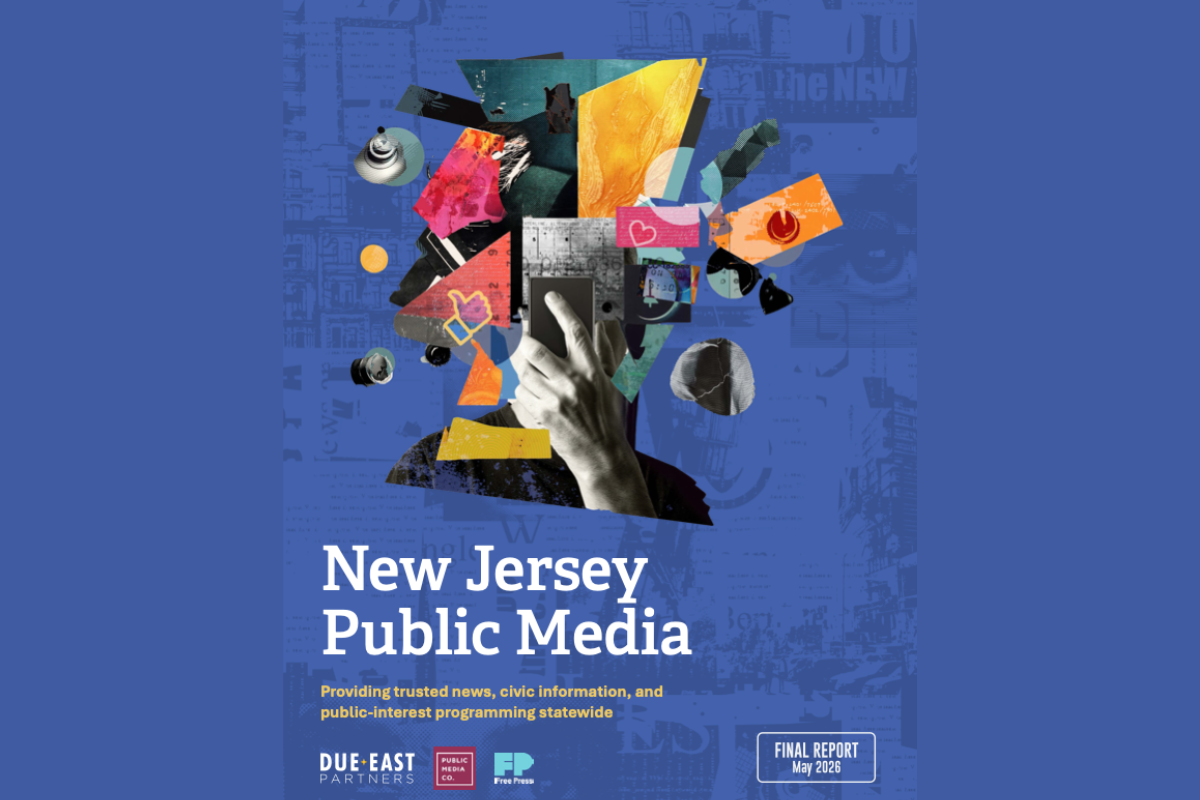
This moment has rallied state leaders to dream up something better for the place they love and call home. The New Jersey Public Media Ecosystem Report published earlier this month lays out a holistic vision where “people across New Jersey have access to innovative, independent and sustainable public media that informs, educates and reflects their communities.”
Co-authored by Due East Partners, Public Media Company and Free Press, the report captures these discussions, lays out a bold and innovative approach for strengthening the state’s information ecosystem, and explains how New Jersey could build a more coordinated system to support trusted news, civic information and public-interest programming for residents.
This includes bringing together the state broadcaster, the NJCIC, the Center for Cooperative Media at Montclair State University, and many other partners in a collaborative effort to produce and distribute public-interest news and programming statewide; strengthen the local-news infrastructure through partnerships, trainings and support; and invest public and philanthropic funds to ensure local communities have quality civic information about where they live.
As the report lays out, public media would move beyond solely broadcast and instead seek to create “a system of independent media organizations and content creators serving the public interest and public good — strengthening civic life, community connection, and democratic participation.”
Simply put: Public broadcasting + public grantmaking + statewide infrastructure support = a holistic public-media system that looks different than anything else. This would create one of the strongest and most innovative public-media systems in the country.
The people have spoken
What was most inspiring about this effort was how much the public was actually involved, something that is often missing in discussions about the future of public media. Free Press led the public-engagement process so that key stakeholders could weigh in on how their tax dollars should be spent to better inform New Jersey residents. What stood out most: how excited people were about what public media in New Jersey could become.
Nearly 70 individuals participated in the process, representing urban, suburban and rural communities across the state, with an explicit focus on immigrant and multilingual communities as well as the often-underrepresented South Jersey region. Key constituencies included local media, community creators, youth, education, civic engagement, philanthropy, arts and culture. The report incorporates people’s honest feedback and advocacy for their communities; these contributions were invaluable and made what was a good idea even better.
To better reach underserved Black, immigrant, rural and low-income communities, important distribution channels like Signal, WhatsApp and multilingual translation were included in this framework and given equal weight to broadcasting and digital channels. The framework also presents ethnic media’s decline as a civic and public-health risk, not just a business problem.
Across all the listening sessions, trust was the defining theme. Participants talked about the need for local newsrooms to be credible, independent and representative of the communities they serve. Trust in local reporting and journalists, or the lack thereof, was a particular concern for youth, immigrant and multilingual communities, as well as those seeking civic-affairs coverage. Stakeholders also highlighted that sustainability for public media depends on whether it has the trust of the communities it serves.
What local communities told us they need
In a detailed analysis of the stakeholder sessions, critical themes emerged.
- The public as co-creators and participants, not just consumers: Those within and outside the journalism field spoke about a need to redefine how the public participates in local-news reporting. This could include further engagement, listening sessions, collaboration and an increase in media-production training. Across sectors, there is strong demand for residents, youth and creators to be directly involved in storytelling, with training and compensation.
- Local, relevant and actionable information is a priority: People want journalism that will help them make sense of an increasingly complex world so that they can better connect with and understand their communities, access basic resources and navigate civic life. Coverage should prioritize information needs related to local government, schools, environmental issues, local sports and social services.
- A fragmented media system is making good information hard to find: Participants said they struggle to find and trust quality information in their day-to-day lives. What news they do have access to is scattered across sources, sometimes behind paywalls or in languages they don't speak. People are inundated with misinformation and clickbait. Access to quality local news varies widely by geography, with accountability gaps in many communities.
- Representation, access and distribution need to evolve: We need systemic solutions to address persistent gaps in who is covered and who has access to relevant content. These gaps disproportionately impact BIPOC, immigrant, working-class and rural communities. In addition, participants spoke about how young people and students are turning to other platforms and distribution channels to search out trusted information. Digital and community-based channels are key to improving access and reach, while investments in community-based media creation are needed to boost trust and representation.
- Sufficient and long-term funding for sustainability of local news: All participants recognized that local and public media are facing challenging economic headwinds. Long-term, adaptive investment in a mix of centralized and community-based media infrastructure is essential to preserving and strengthening the public-media ecosystem.
Opportunities and challenges abound
New Jersey remains a national leader in innovative solutions to the local-news crisis. It’s home to some of the hardest-working journalists in the country (and I’m not just saying that because it’s where I cut my teeth as a reporter). Some of the nation’s most promising civic-media initiatives started or have taken root in New Jersey, such as The Jersey Bee, Radio Cosecha and the Documenters program. NJ Spotlight was a forerunner to the nonprofit-news boom and has powered the NJ PBS newsroom in recent years. Even with its fiscal challenges, NJ PBS is still delivering high-quality daily reporting and is one of the few public-TV stations in the country to still air a locally focused nightly newscast.
New Jersey’s durable media infrastructure is due in part to its collaborative and creative nature, which is why countless initiatives here have inspired similar efforts elsewhere around the country, including legislation modeled after the NJCIC that’s moving forward in several statehouses.
The people we spoke with were also clear-eyed about the challenges ahead. After all, people from New Jersey speak their minds.
Barriers to producing, accessing and trusting local media remain. New Jersey ranks 49th in the country in journalists per capita, something that came up time and again during the listening sessions as stakeholders named gaps in coverage in both specific geographies or in beats like accountability reporting. People spoke about how hard it is for good information to break through their toxic newsfeeds. Many stakeholders shared that their cultures, identities and everyday experiences are missing or selectively portrayed in current media.
And then there’s the money. The report calls for the state to invest $55 million over five years into the new public broadcaster and the NJCIC (which is more than the state’s current annual appropriation for NJ PBS and the NJCIC but less than what we saw in years past). Some people expressed skepticism that the state would allocate more money to a new public-media system, while others said the amount named in the report should be higher.
“Substantial public resources and long-term sustainability remain a large question, especially as the state grapples with tight budgets annually,” says the report. “Public media leaders and lawmakers will need to verbalize commitment to a new approach and back that up by moving away from yearly appropriations and commit to long-term sustainability.”
New Jersey can lead once again
When we first began the campaign to create the NJCIC, policymakers often laughed us out of rooms while media professionals offered their well-earned skepticism about the state ever taking action in support of local news. Too often, big ideas are scuttled or seen simply as something that “wouldn’t work in the real world.” I’m happy to report that the NJCIC campaign not only proved those doubters wrong, it showed that you can engage the public to stand up for local media so long as they can see how it will serve them.
Gov. Sherrill and the legislature have made it clear that civic engagement and combatting misinformation online are priorities. Investing in the NJCIC and the future of public media is how the state can do that.
The landscape we’re in now echoes where we were back in 2018 when the legislature created the NJCIC. With a generational opportunity before it, New Jersey can do the impossible again. It can build public support for informed communities and make the case to decision-makers so they treat civic information as the public good it is.
About the author
Mike Rispoli is the senior director of journalism and civic education at Free Press. He focuses on winning public policies to transform local news and create equitable access to information that promotes civic participation and thriving communities.
The kicker
“The cost is modest. The stakes are not. At $1.25 per resident annually, New Jersey can lead the nation with a public media system that counters misinformation, reflects every community, and strengthens democracy from the ground up. … That’s not just good policy, it’s what the people of New Jersey asked for.” —excerpt from the New Jersey Public Media Ecosystem Report