Want Better Media? Start by Listening to What Communities Say They Need
We have a lot to learn from community broadcasters in rural America


I’ve been thinking a lot lately about the questions we ask before we decide what a community needs.
For those of us working in public media, journalism and civic information, we often begin with the institutions we know. How do we sustain local journalism? How do we replace reporters who have lost their jobs? How do we strengthen a newsroom or grow an audience?
Those are important questions. At the National Federation of Community Broadcasters (NFCB), where I’m the CEO, our recent research has pushed us toward a different starting point: What do people need from the places where they live, and what role can local media and other trusted institutions play in meeting those needs?
That distinction feels particularly important as states, funders and organizations working to strengthen civic information consider investments in local journalism. There is an opportunity not only to preserve media institutions, but to better understand the information ecosystems communities already have, where the gaps are, who people trust and what they say they need.
Looking more closely at rural communities
NFCB represents 201 community-radio stations across the country, and 63 percent of our members serve rural communities. They include small independent stations, tribal broadcasters, multilingual stations and volunteer-powered organizations, many of which operate with remarkably small staffs and budgets.
These stations often do much more than what we traditionally think of as broadcasting. They share emergency information, announce road closures and school cancellations, cover local government, promote local organizations, preserve languages and musical traditions, and create places where people hear voices they know.
That experience is one reason NFCB has become increasingly interested in community radio as civic infrastructure.
In 2024, NFCB participated in the Researching Unmet Needs Study, one of the largest audience-research projects conducted in public media. The RUN Study raised additional questions for us about rural communities. At the same time, rural stations were seeking better information about the people and places they served. Many small stations cannot afford to conduct audience research or commission community studies themselves.
We needed research designed specifically around the experiences of rural communities. That became NFCB’s Rural Research Study. Rather than simply asking who listens to community radio, we wanted to understand people’s lives more broadly. Where do they find information? What do they trust? What services are difficult to access? How do they participate in community life? What helps them feel connected? What role do music and culture play? Where does community radio fit within all of this?
The Civic Information Index
Around the same time, Listening Post Collective’s Civic Information Index, a data project that maps civic engagement and health, offered another useful way to think about information needs.
This project helps us pinpoint where we should look more closely. It encourages us to look beyond whether a place has a newspaper or newsroom and consider information access within the broader picture of civic health.
Data can show us where something deserves attention. But an index cannot tell us precisely what a particular community needs. We have to ask people what those patterns mean in their lives.
A community may technically have broadband, but it can still be unaffordable or unreliable for residents. A county may have a news organization even as residents still struggle to find useful information about public services or local government in a form that works for them. Having information available does not necessarily mean people know where to find it, trust it or receive it in a form that works for them.
For me, the Civic Information Index is most useful when it becomes a starting point for listening rather than a substitute for it.
A thinner safety net
Rural Americans are not as fundamentally different from everyone else as our national narratives sometimes suggest.
People everywhere want safety, opportunity, access to services, reliable information and connection to their neighbors. The differences become clearer when we look at the infrastructure surrounding those needs.
Our Rural Research Study found that rural respondents had a more difficult time accessing crucial services. That included public transportation, health care, child care, elder care, mental-health services, local news and information, emergency services and libraries.
Internet access offered another example. Rural respondents were less likely to have fixed broadband and more likely to rely on satellite internet. They had a harder time finding affordable options and were less satisfied with the availability of alternative providers.
Our research partners at City Square Associates helped us think of this as rural America experiencing many of the same needs as the rest of America, but with a thinner safety net.
That framing has stayed with me. When one local institution disappears, there may not be another nearby. If broadband fails, alternatives may be limited. If a local newsroom shrinks, there may not be a reporter available to cover the county.
What happens when you go deeper
NFCB’s partnership with Listening Post Collective through Signals from the Airwaves gave us an opportunity to take the next step.
Beginning in 2025, five rural community-radio stations received funding, tools and coaching to conduct structured community-listening sessions: KKCR on Kauaʻi; KWSO in Warm Springs, Oregon; KUYI Hopi Radio in Arizona; WMMT in Eastern Kentucky and Allegheny Mountain Radio, which serves communities in Virginia and West Virginia. Four of the five had never previously conducted formal community-listening sessions.
What happened next demonstrated why national research and local listening work so well together.
On Kauaʻi, residents told KKCR they wanted more locally specific information about housing, tourism, infrastructure, environmental protection and government accountability. Rather than trying to build an independent newsroom with resources it lacked, KKCR began developing a more collaborative model with other news organizations while concentrating on the hyperlocal information it was uniquely positioned to provide.
At KUYI in Arizona, community members identified the need for clearer emergency and public-safety information. Almost half of respondents relied on one device for internet access — usually a smartphone — while reliable Wi-Fi remained uncertain or unavailable for many households. The station began using those findings in conversations with Hopi law enforcement, emergency services and tribal leadership.
At WMMT in Eastern Kentucky, listening surfaced gaps around disaster preparedness. The station subsequently helped establish the Letcher County Emergency Preparedness Cohort, bringing together first responders, public officials, mutual-aid workers and community leaders.
And at KWSO in Oregon, residents reminded us that useful information systems don’t always have to be technologically sophisticated. People relied on radio, social media and word of mouth, but they also relied on physical bulletin boards. KWSO responded by exploring electronic information displays in places residents already visit.
Just counting news outlets couldn’t have predicted any of these responses. Someone had to ask.
Information travels through relationships
Our listening sessions also found that real information ecosystems can be messy.
Important information moves through government agencies and news organizations, but it also moves through grocery stores, post offices, hospitals, churches, community events, bulletin boards and conversations between neighbors. Understanding an information ecosystem requires looking at both official and informal channels.
It also means going where people already are. Stations listened at coffee shops, farmers’ markets, community workdays, celebrations, graduations and bluegrass events.
That represents an important shift. We cannot understand a community only by talking to the people who already listen to us, subscribe to us, attend our meetings or answer our emails. Sometimes the most important voices are the people we are least likely to hear through our usual channels.
Civic and emotional infrastructure
We generally associate infrastructure with roads, bridges, broadband networks and buildings. But communities also rely on civic infrastructure — the relationships, institutions, places and practices that help people communicate, participate, solve problems and care for one another. Community radio can be part of that infrastructure when it helps people understand what is happening around them, prepare for emergencies, connect with resources and hear from their neighbors.
Our Rural Research Study also pushed us toward another idea: emotional infrastructure.
Take music and culture, which have always been central to community radio. What became clearer to me is that music and culture are not separate from community connection. Music preserves memory. It carries language and tradition. It introduces us to local artists and creates shared experiences across generations.
If civic infrastructure helps a community function, emotional infrastructure helps people feel they belong to that community. That matters because trust, identity and belonging influence whether people seek information, whom they believe and whether they participate in civic life.
Listening changes organizations, too
Listening didn’t just produce information about communities. It changed the stations.
The process strengthened relationships with community organizations, tribal departments and emergency-response entities. It also gave stations stronger evidence to explain their value based on what the community told them they needed.
Stations increasingly saw evaluation not just as something done to satisfy a funder, but as a tool for questioning assumptions and making better decisions. For people working on state investments in journalism and civic information, I think there is something useful in putting these pieces together.
The Civic Information Index can help identify places where we should look more closely. Research can help us understand broader patterns. Community listening can tell us what those patterns mean in a particular place. What comes next will not look the same everywhere.
One community may need another reporter. Another may need stronger communication between broadcasters and emergency managers. A tribal community may need information delivered differently for elders. Another community may have good journalism but no reliable way to reach residents when broadband fails.
This does not make journalism less important. It places journalism within the larger ecosystem in which people actually live.
Investments in civic information should also leave room for listening itself. Small rural organizations often lack the staff and resources required for sustained community engagement. If we want institutions to listen, we have to recognize listening as work worth supporting.
Asking a better question
When NFCB started this research, we wanted better information about rural communities because our stations were asking for it — and because earlier research showed us how much more there was to understand.
I didn’t anticipate how much this study would change the questions I was asking.
I started by thinking about what rural communities need from community radio. I am now much more interested in what rural communities can teach us all about building healthier information ecosystems.
Now comes the harder part. We have to decide what we are willing to do differently because of what we heard.
That’s the question worth carrying into the next generation of civic information work. It’s not just how do we save local journalism? But what does this community need to be informed, connected, safe and able to participate in its own future — and how can journalism, community media and other trusted local institutions help?
For NFCB, that is increasingly where the work is headed: Begin with the community, listen carefully, understand the existing information ecosystem, and invest in the civic and emotional infrastructure that helps people and places thrive.
About the author
A. Rima Dael is the CEO of the National Federation of Community Broadcasters, a nonprofit strategist and public-media leader advancing community media, civic information, partnerships and organizational resilience.
Teamwork
Compiled by Pressing Issues editors
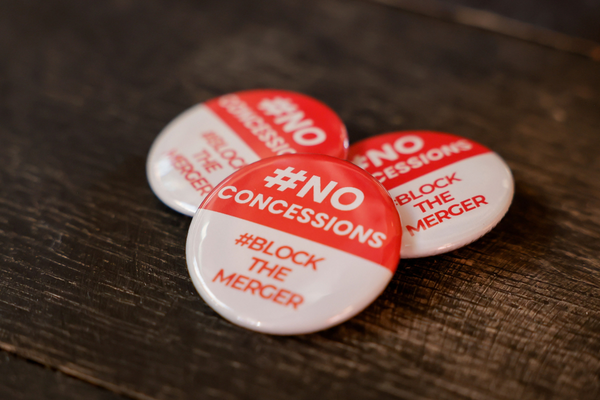
An “authoritarian takeover attempt of our media system.” Earlier this week, Free Press Co-CEO Jessica J. González appeared on Democracy Now! in a wide-ranging interview about major media news, including the lawsuit against Meta, ABC’s lawsuit against the Federal Communications Commission and the ongoing fight to stop the Paramount-Warner Bros. merger.
“This is the authoritarian takeover attempt of our media system, and we’re not going to let it happen,” González said.
Allied forces
“Near + Now” in public media. The Public Media Journalists Association (PMJA) is replacing its traditional annual conference with “Near + Now,” a series of four regional professional-development events open to anyone who works in public-media production.
Here are the first two events:
- “Move the Needle: The Work That Keeps Newsrooms Running,” Aug. 26 in Indianapolis
- “Emerging Tech & AI: Tools, Ethics & Smarter Workflows,” Sept. 9 in New York
You can visit the PMJA site for more information.

The kicker
DUN, DUN, DUN, DUN-da-DUN, DUN-da-DUN