Saying No to AI Slop — and The Baltimore Sun
Certain journalistic lines just can’t be crossed

A few months ago, perhaps out of both curiosity and fear, I asked an AI chatbot to draft a hypothetical 800-word opinion piece in the style of my writing voice. After taking seconds to analyze years of my journalistic work, the chatbot delivered a “draft” that was both laughable and sad to read. I was also angry that the draft reduced decades of my own creativity to what it thought was a polished and publishable article. It felt cheap and mediocre.
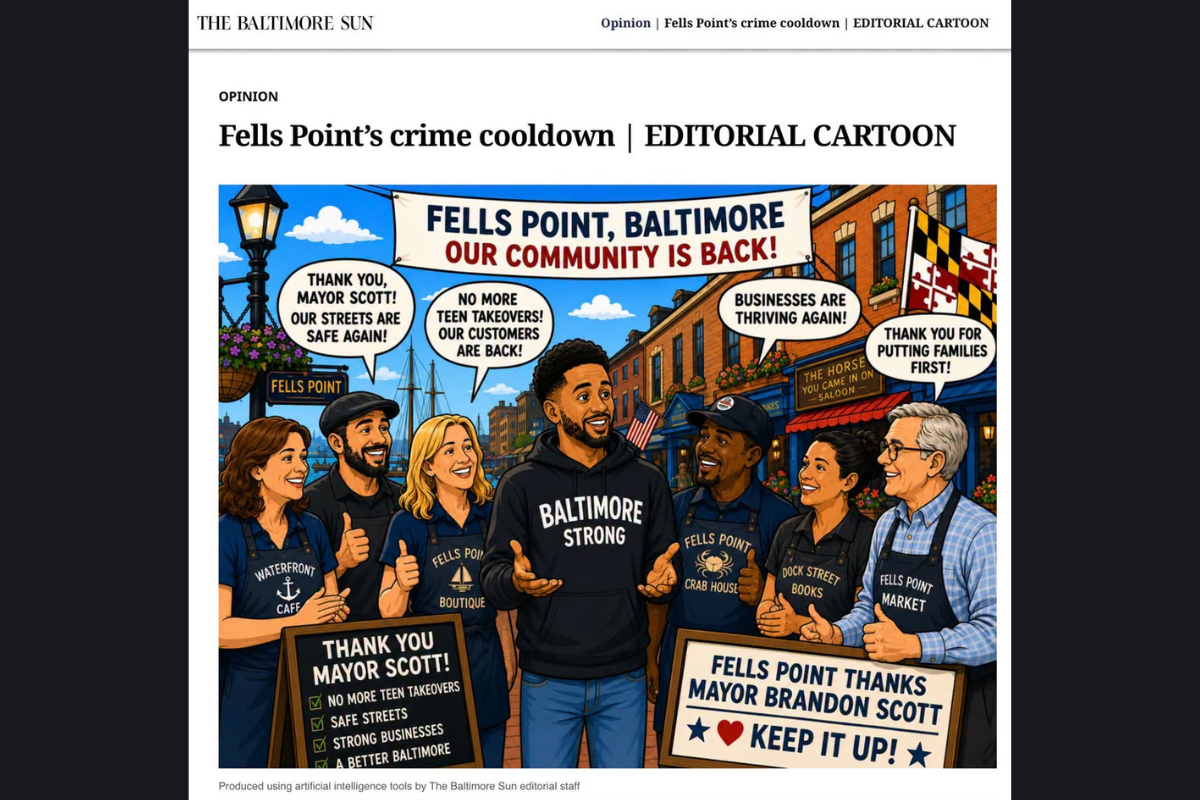
When I started seeing Facebook posts earlier this month about how The Baltimore Sun was now generating AI cartoons on its editorial pages, the anger came back. One specific cartoon represented everything AI slop cannot do in the creative space. The image of Baltimore Mayor Brandon Scott meeting with supporters features bizarre dialogue balloons, deer-in-the-headlights gazes, random checklist items and the most unattractive sweatshirts ever. It just feels fake and embarrassing. By the way, those creepy AI images have become a regular thing for The Sun.

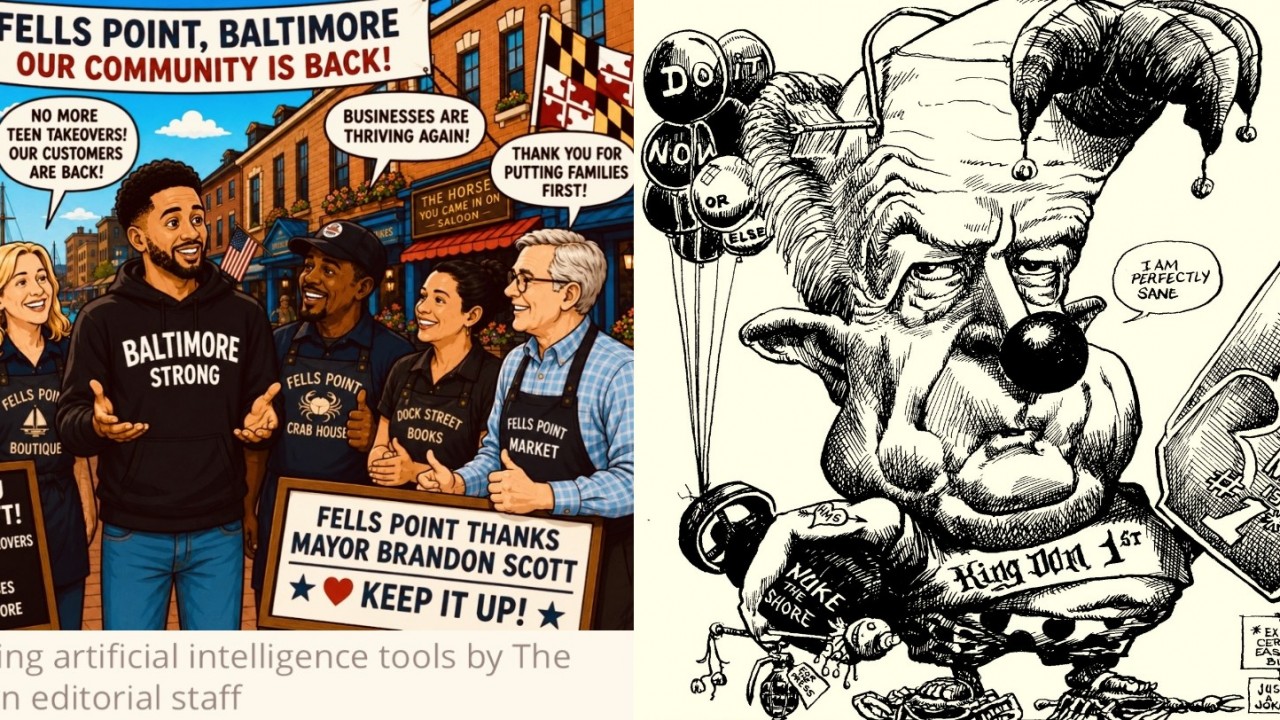
Nobody should be surprised. In 2025, the outlet fired editorial cartoonist Kevin “KAL” Kallaugher, a two-time Pulitzer finalist who had worked there since 1988. Known for his scathing political cartoons — particularly of Donald Trump — Kallaugher attributed his firing to right-wing Sun owner David Smith. You may know him better as the executive chairman of Sinclair — the giant local-TV broadcaster that controls hundreds of local stations, including its Baltimore flagship, and is best known for forcing its anchors to parrot conservative talking points. Smith purchased The Sun in 2024, pushing the outlet more to the right and onto a path of irrelevance.
 megan_cattelharvard.edu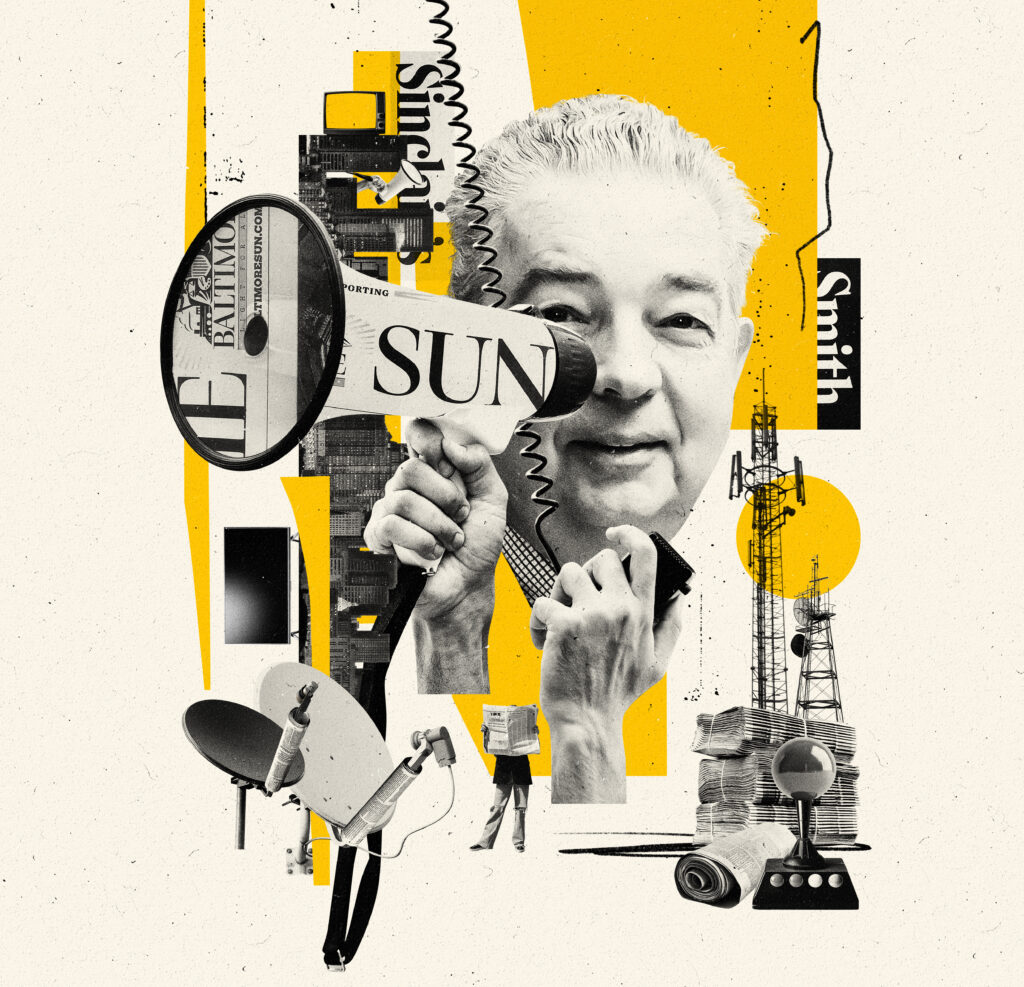
“The Sun let me go a year ago only to replace me with AI slop,” Kallaugher wrote on his Substack, adding in a Facebook post that it is “an embarrassment from a once reputable publication.”
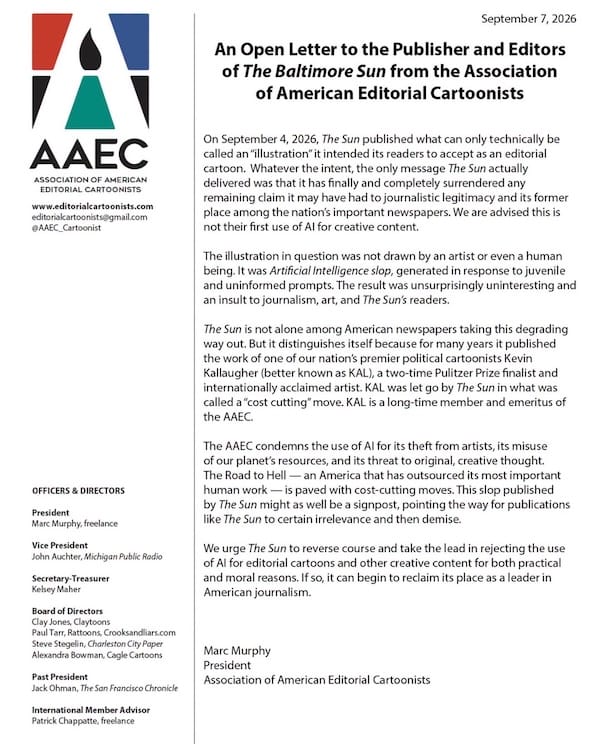
As I learned more about this story, I came across a Facebook post by award-winning cartoonist Clay Jones, who shared an open letter to his 19,000 followers from the Association of American Editorial Cartoonists (AAEC) about The Sun’s AI slop.
“The only message The Sun actually delivered was that it has finally and completely surrendered any remaining claim it may have had to journalistic legitimacy and its former place among the nation’s important newspapers,” the AAEC letter reads.
“The AAEC condemns the use of Al for its theft from artists, its misuse of our planet’s resources, and its threat to original, creative thought,” the letter adds later. “The Road to Hell — an America that has outsourced its most important human work — is paved with cost-cutting moves. This slop published by The Sun might as well be a signpost, pointing the way for publications like The Sun to certain irrelevance and then demise.”
Jones is a member of the AAEC’s board of directors whose work has been nationally syndicated since 2000. He created his own syndication company, Claytoonz, in 2013, and won the Robert F. Kennedy Human Rights Journalism Award for Editorial Cartooning in 2022.
On Monday night, we spoke over the phone about The Sun and its love of AI slop.
This conversation has been edited for length and clarity.
Julio Ricardo Varela: Why issue this open letter now?
Clay Jones: I’m always outraged when I see this stuff. I’ve been worried for years that legitimate mainstream newspapers would eventually replace us with AI. I remember when this stuff first started emerging, like a year or two ago — they would start sharing these cartoons that didn’t look like they were created by the same person. And I remember some papers making statements that they would never use it or that their ethics policy would prohibit them from using it.
One of my clients uses AI for advertising, and I asked them about their policy. I didn’t want to lose a client in the process, but when I asked, I didn’t get much of an answer. They just pretty much acknowledged they were using it.
We’ve been worrying about this happening, and when it does, you’re almost overreacting and saying that it’s not going to happen, and then oops, it just happened.
I raised the issue with the AAEC, and everyone agreed that we had to publish a letter. Why now? The answer to that is because we just found out about it. If we had already seen a similar example before, we would’ve jumped earlier.
JRV: What was your reaction when you saw The Sun’s AI illustration?
CJ: I wanted to throw up. When I see a newspaper that’s actually using AI, it lends it legitimacy. I worry that other newspapers will start doing it more because they see The Baltimore Sun, which used to be very esteemed. When I came into this business, I highly respected The Sun. They had Kevin Kallaugher working for them. And I worry that all this happening now will influence other newspapers to think it’s OK. If The Sun can do this, that means we can do this. We don’t need ethics policies about this. And if we do have an ethics policy about it, we can just ignore it.
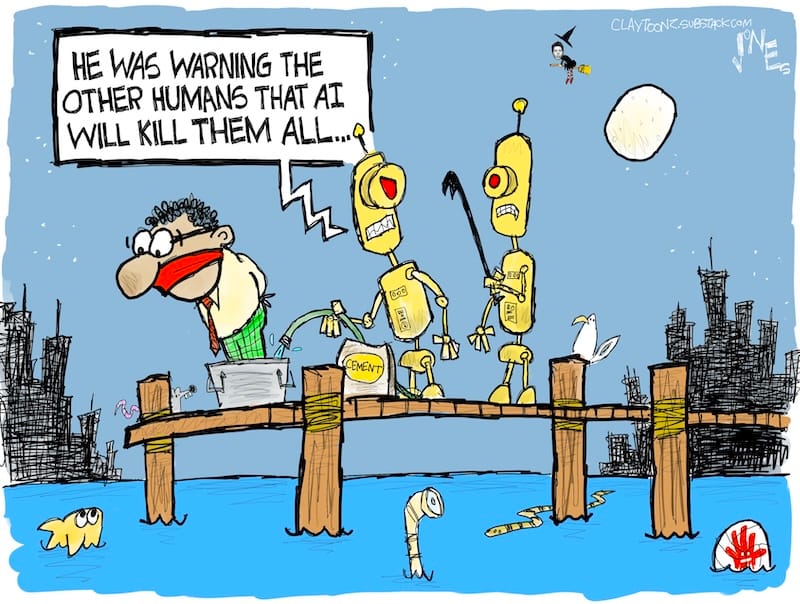
I do think, as they say, AI’s going to kill us all. It may not slash my throat while I’m sleeping, but it may actually go from killing our careers to killing us literally.
JRV: How do you fight back?
CJ: That’s a great question because we don’t have the answer to that. What do we do? We write an angry letter. We all get together and complain about it. The Sun deserves to be called out for it. They deserve to get letters. I can’t do anything about it as one person. Even my entire association can’t do anything about it. We’ve always been pretty powerless as political cartoonists. Hopefully, what comes from this is that while we don’t have much power, our readers do.
And we could actually inspire our readers to do something about this. Number one, stop sharing all this. Stop using AI to do this. I didn’t realize how easy it was until one of my buddies showed me that an AI app could copy my own style, and it totally looked like shit. It is theft. And readers don’t really notice it.
I don’t make any exceptions for AI. I don’t care how funny you might think it is. But wherever they use AI, the people who write the stuff, it also shows why they’re not professional cartoonists, because the writing is terrible. I’ve been a professional cartoonist for 36 years, and I’m pretty sure that for all those years, the people who would always submit the worst ideas for political cartoons were my editors. Editors are the worst writers when it comes to cartoons.
It’s hard enough getting them to approve ideas, but they can’t write them. And of course, they think they can. And now they’re literally writing cartoon ideas, and they’re telling a computer how to do it, and they’re doing it by committee.
That’s exactly what that Baltimore Sun cartoon looked like. It looked like a bunch of editors in a committee sat down and wrote it with 17 labels. And everything in that cartoon is literal, with people just standing around, making somebody feel good, and saying something nice about somebody. That’s exactly what editors want.
They don’t know how to write a cartoon, and you can’t teach somebody how to write a cartoon. You write cartoons by drawing cartoons. You go out there, and you fail. You draw a lot of bad cartoons, and at some point, you start to understand how to do it.
The power of the political cartoon will fade if these are the political cartoons of the future. But the other thing is that they all look like basic, generic crap.
They’re worse than dogs playing poker on velvet.
JRV: So what’s going wrong in journalism? Is it the ownership? Why are we seeing these AI drawings?
CJ: First off, they’re cheap, and editors, they’ve always been pretty cheap for the most part. Now they’re just doing stuff that they can just do for free.
I’ve been away from being a staffer for over a decade now, but it seems to me that some of the people in the higher-up positions may not have as much actual on-the-ground journalism experience. Have they been to a city hall to cover a meeting? Have they taken stock photos of someone catching the biggest catfish in town?
I came up as a rural newspaper person. My first job was at a weekly where I’d get ink underneath my fingernails. It was a regional paper where you’d have to do 20 different jobs. Nobody had just one job. You might have a specialty, but you weren’t too good to sweep the floor, make the coffee or write an obituary.
When I think about the people who oversaw editorial pages when I was coming up, the people who I would argue with about a cartoon, I would think those people would still bristle and resist some AI crap doing their job for them.
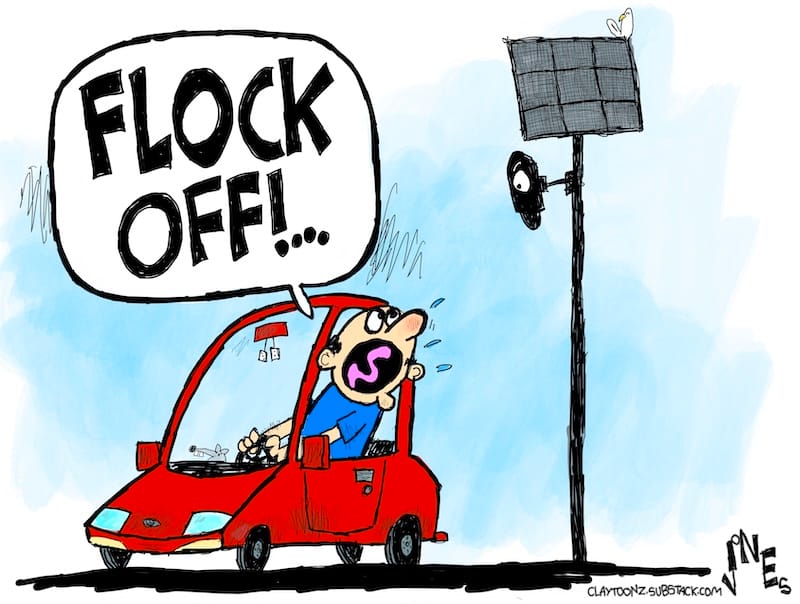
When they fire cartoonists, or when they replace them with a syndicated service, that’s one thing. But now we’re just going to have this app, this computer software, write our content for us. This is worse than anything that you see in science-fiction movies. What, all of our news is going to be written by some computer? And if they can get a computer to do political cartoons or write an article, who says that computers or software can’t become editors or eventually publishers?
We need the readers, but I think one thing we can do, which probably isn’t gonna work, is that we just gotta shame everybody who uses it. Remember that show called The Good Place from a few years ago? One of the insults from the show was “You’re basic.” Meaning that you are just plain or ordinary, or you think something’s clever, but no, you’re just basic. That’s pretty much what you are if you use AI. You’re basic.
And we just need that to take off.
Teamwork
A Massachusetts update. I am taking a moment to uplift the incredible work my Free Press colleague Sarah Stone is doing in Massachusetts. In a blog post on the Free Press website, Sarah shares the latest on our Massachusetts Media Power Collaborative — a coalition dedicated to securing public funding to treat local news as the essential public good it is. As a journalist who has called Massachusetts home for more than 30 years, I consider this goal close to my journalistic heart.
 Sarah Stone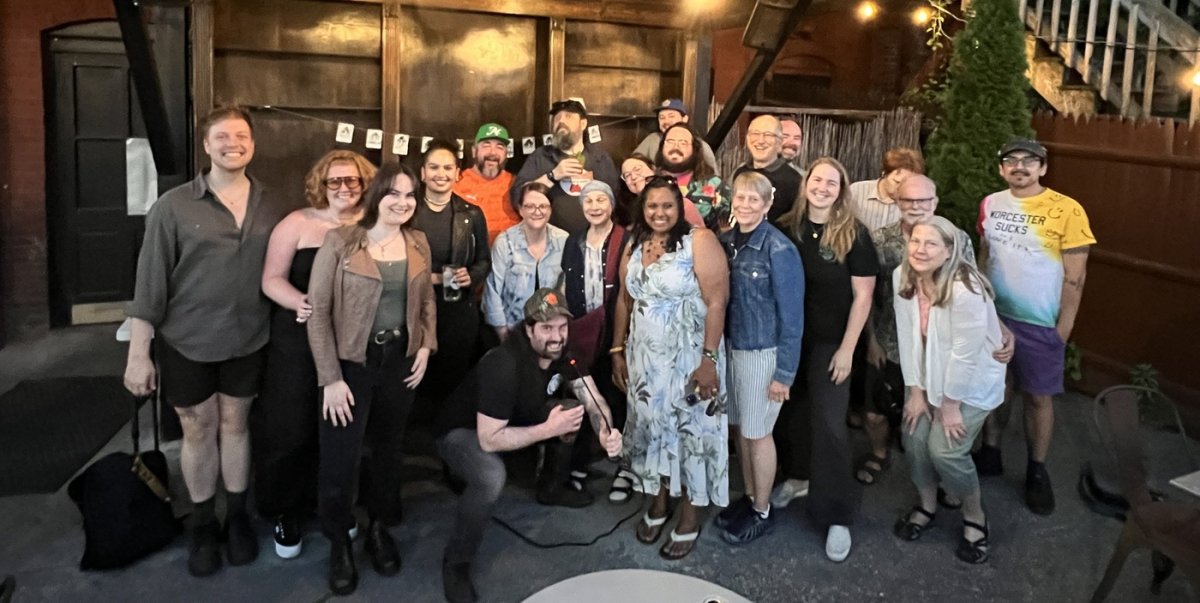
The kicker
“We see much injustice in media as we gather today. We witness the cold machinery of artificial intelligence, programmed with the biases of our past, reinforcing the walls of systemic discrimination that Dr. Parker strived to dismantle. We see the dangerous consolidation of media ownership, where the voices of the poor and the marginalized are drowned out by the roar of corporate profit. We see the fracture of our shared reality, where disinformation spreads like a plague, turning neighbor against neighbor in digital echo chambers of suspicion and distrust. Grant us, we pray, wisdom and courage for the living of these days. May our commitment to media justice be a bridge across the divides, a tool for healing, and give testament to the inherent dignity of every human soul.” –Rev. Freeman L. Palmer, from his invocation at the United Church of Christ Media Justice Ministry’s 44th Everett C. Parker Lecture