Studios Forsake LGBTQ Representation at Their Own Peril
Q&A with GLAAD’s Associate Director of Entertainment Research and Analysis Raina Deerwater about the “Where We Are in Film” report
Does art imitate life or does life imitate art? As someone working on media representation and justice, the answer is clear to me: It’s both.
Art and life are always in a complicated dance — at times mirroring each other’s moves, other times soloing in their own directions, and sometimes, teaching each other difficult steps. This interplay is part of why the battle over representation — who gets to make movies, decide the name of various bodies of water, even coin the terms of debates (think “forced birth” versus “pro-life”) — matters so much.
And it’s visible in all sorts of social-justice movements, from racial equality to LGBTQ rights. The stories we tell, who tells them and on what platforms matter profoundly, shaping our shared understanding of the world around us. Culture precedes policy, as they say, so getting the laws we want might just start with getting the movies we want made.
Take, for example, groundbreaking, if imperfect, shows like Will & Grace, The L Word and Queer as Folk — they helped lay the groundwork for marriage equality.
Now, more than 20 years later, we’re seeing our government curtail the power of art. President Trump is working to turn the media into a propaganda machine, and too many of the major conglomerates are happy to play along. Unfortunately, representations of trans people offer a clear example. Trump’s cowardly efforts to scapegoat them resulted in literally zero trans representation in all the films from the top-10 studios last year.
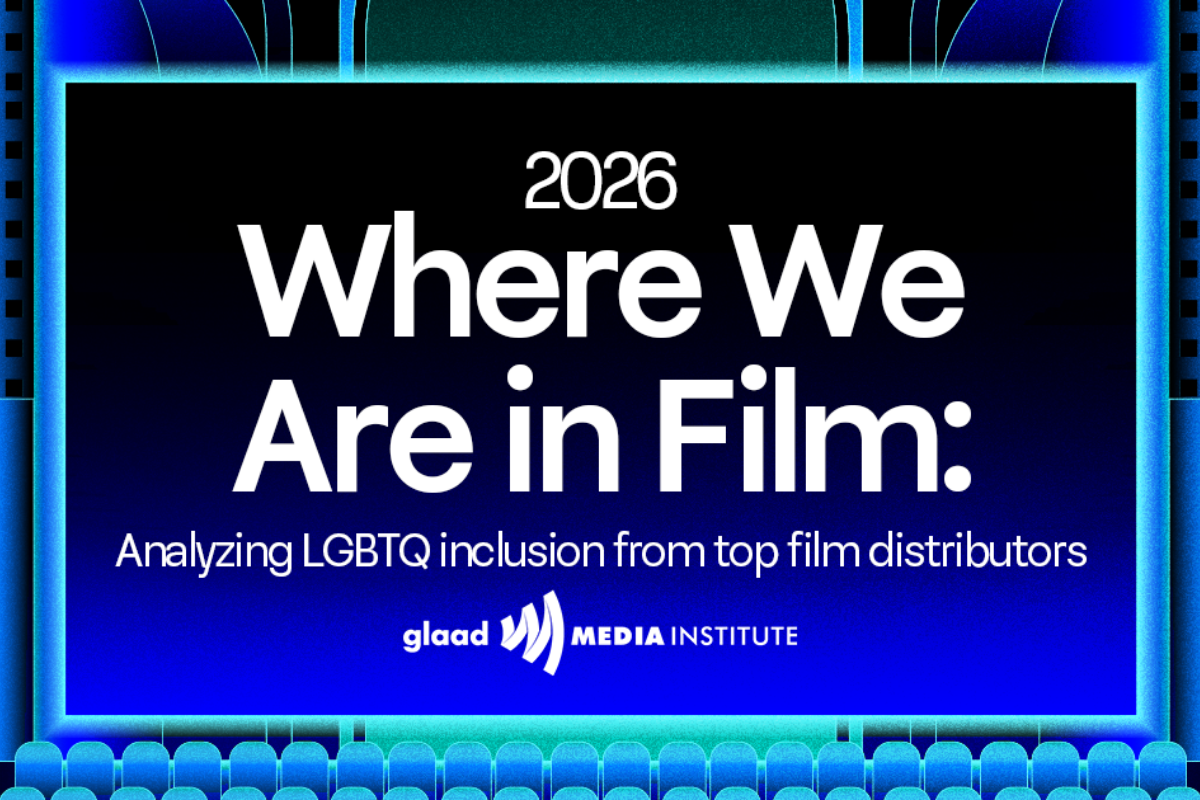
That’s just one of the revealing findings of GLAAD’s Where We Are in Film report. To find out more, I spoke with Raina Deerwater, the report’s lead researcher and author. With the LGBTQ advocacy and cultural-change organization since 2016, she serves as associate director of entertainment research and analysis. Her award-winning work measures LGBTQ inclusivity and diversity in television and film.
This conversation has been edited for length and clarity.
Cristina Escobar: What is your goal with the Where We Are in Film report?
Raina Deerwater: Where I grew up, in a super-small town, there was one movie theater that had four screens. There should be a film playing in those theaters that is inclusive of our community. Our community exists, it’s in the world, we’re around. We should be in movies as well. So that’s the goal — to talk about representation in mainstream film and point out ways it’s great and ways it’s not so great.
The report also exists as a benchmark and source of truth because a lot of times, you’ll hear anecdotally, “every time I go see a movie, there’s a gay person in it” or whatever. It’s good to have specific evidence: Here’s every film that the 10-biggest distributors in the U.S. have put out, and this is how many have our community represented in them.
CE: The LGBTQ community is a favorite target of this administration. Can you share how its continued efforts to demonize your community show up in film and particularly in the numbers you are tracking?
RD: One of the numbers that wasn’t shocking, but was really disheartening, is that there were zero trans characters in any of the films. GLAAD looked at 225 films, and none of them had trans people in them — and that is the community that is most under attack right now.
There are other numbers that someone else at GLAAD is tracking — the number of local anti-trans legislative bills that have been introduced, for example. And there’s the federal push for a lot of terrible anti-trans stuff. There is this misconception that the masses agree with these policies.
Unfortunately, right now, a vocal minority has a lot of power in the government. And instead of talking about things like health care and grocery prices, they’re talking about the two trans women who, God forbid, tried to play a sport this year.
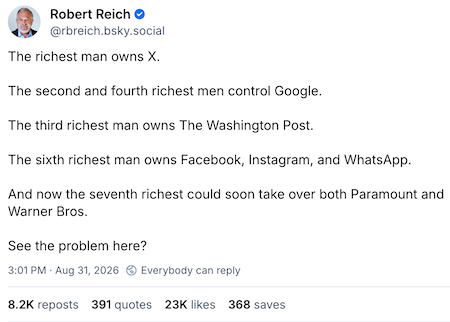
This targeted attack on the trans community has bled into film and television, especially at major studio films, which are owned by really big conglomerates that want to get their mergers approved by the government.
The major studios have fallen into this trap of not producing things that represent this government’s targets. For the last three years, there’s been a decline in LGBTQ characters of color, which maps politically onto what’s happening right now. It’s this unfortunate thing where there’s an overall decline, but the more marginalized groups are declining at an even larger rate.
CE: Can you tell me how the lack of LGBTQ representation in media affects your community?
RD: As Roger Ebert said, film is an empathy machine. And for that to work, the film doesn’t need to be about a certain experience. We may get a film about someone coming out or someone transitioning, and the conflict is someone’s identity.
What we really want to see is a rom-com or a superhero movie, and you’re like, ‘Oh my god, I love Spider-Man or When Harry Met Sally. You love the characters for who they are, their actions, their quirks. What happens if one of those beloved characters also happens to be gay, also happens to be trans? Then, I’m rooting for this character, even if I don’t know a trans person. That’s humanizing. It makes people more than just a talking point on Fox News. Fiction can make something more real, and that’s such a powerful thing for movies in theaters that reach a broad audience.
CE: Free Press submitted comments condemning the FCC’s idea of putting warning labels on children’s programming with trans or nonbinary characters. How does your report push back on that particular attack?
RD: It’s not an exact one-to-one because the report’s about film, and the FCC was proposing to regulate TV. The connection is with kids and family programming. In this report, we found zero inclusion in animated and family films. That’s not a coincidence.
The government is selling an untruth that Hollywood is indoctrinating our kids through media. But a queer kid is queer no matter what. And if they seek media with queer people, they can maybe see a future and a community for themselves. And for people who aren’t in the LGBTQ community, it can help them better relate to their queer son or niece or whatever.
Specifically for media aimed at younger people, there’s this incorrect notion that being LGBTQ is an adult thing. So many people have queer parents, queer classmates, queer teachers. We are not adult content. We just exist in the world, and it’s wild to paint the portrayal of people that exist as “adult” when we’re just around.
CE: I hear you describing this downward loop where politics and media are feeding off each other to curtail people’s rights. How do we flip it so we get into a positive loop?
RD: That’s a big question. Going back to film specifically, independent filmmakers are seeing great success outside of the studio system because they don’t have to go through all those roadblocks. Artists are doing a lot creatively in terms of inclusion but also in terms of storytelling — telling stories we maybe haven’t heard before, including voices we maybe haven’t heard before.
Those films are killing it on the festival circuit. Those stories are what people want to see.
If you look at what happened at the Cannes Film Festival this past year, two of the biggest titles that came out were Club Kid and La Bola Negra, both of which are queer stories. One was bought by A24, one was bought by Netflix, and these are two studios we track in this study, which is exciting for me. These companies are buying these films because people love them.
It’s coming to a point — are we going to listen to what audiences want or the fear-mongering from the government? I have a lot of hope because Netflix not only bought La Bola Negra, but they’re also doing a one-month theatrical window, which they’ve never done before for any film. And obviously, a lot of that is to get award acclaim, but also it’s really exciting to see an epic queer love story get a big theatrical release from the biggest streamer out there.
The number of Gen Z who are actively going to the movies right now and are investing in physical media are the ones who are driving this. And they’re a generation that’s more queer than every other generation combined. So, according to Gallup — which you know, take with a grain of salt — people want to see these stories, and they are going to see these stories no matter what, whether it’s through the film system or not.
Studios can either take note and listen to their consumers or slowly become irrelevant.
About the author
Cristina Escobar is the senior director of marketing and communications at Free Press. She’s also a cultural critic and the co-founder and editor-in-chief of Latina Media Co, an indie outlet platforming Latina and queer Latinx perspectives. A true millennial, all of her medical knowledge comes from (re)watching Grey’s Anatomy. You can follow her on Instagram @cescobarandrade.
Open tabs
Compiled by Pressing Issues editors
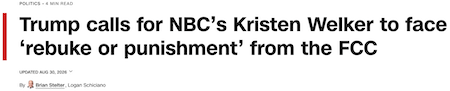
Trump Sics FCC on NBC. Trump is “treating the Federal Communications Commission like his own personal enforcer,” CNN’s Brian Stelter and Logan Schiciano wrote after the president said that NBC News’ Kristen Welker should be “reported to the FCC for rebuke or punishment” because he didn’t like her reporting.
“The FCC has limited power over issues like this, and its own website states the agency ‘cannot prevent the broadcast of any particular point of view,’ so the notion of ‘punishment’ for Welker, the moderator of NBC’s ‘Meet the Press,’ would historically be a nonstarter,” Stelter and Schiciano explain.
But as ABC has learned the hard way, that doesn’t mean FCC Chairman Brendan Carr won’t take Trump’s bait and go after NBC’s broadcast licenses. Even if Carr doesn’t have legal ground to stand on, the chilling effect on reporting is very real.
Secret snoopers. The Trump administration is obtaining private information on journalists, nonprofits and unions using legal moves that don’t require judicial approval, The Guardian revealed. The government was able to obtain six months of journalist Georgia Fort’s phone records from T-Mobile, and was also seeking account information from Fort’s YouTube channel, as well as those of Don Lemon, Democracy Now!, the Milwaukee Journal-Sentinel and even conservative commentator Megyn Kelly.
“There’s a long history of DHS abusing this summons authority in particular,” ACLU lawyer Nathan Freed Wessler told The Guardian, “and using it to seek both records that are clearly outside of its scope in general, and more particularly to try to go after people whose speech DHS is somehow irked by — but whose speech is protected by the First Amendment.”
 Sam Levine
The kicker