Too Long Have Others Spoken for Us
Journalists of color and their continued struggle to democratize our society

Editor’s Note: The following is the transcript of a speech Free Press’ Joseph Torres delivered on Sept. 28 at Borealis Philanthropy’s conference in Chicago.
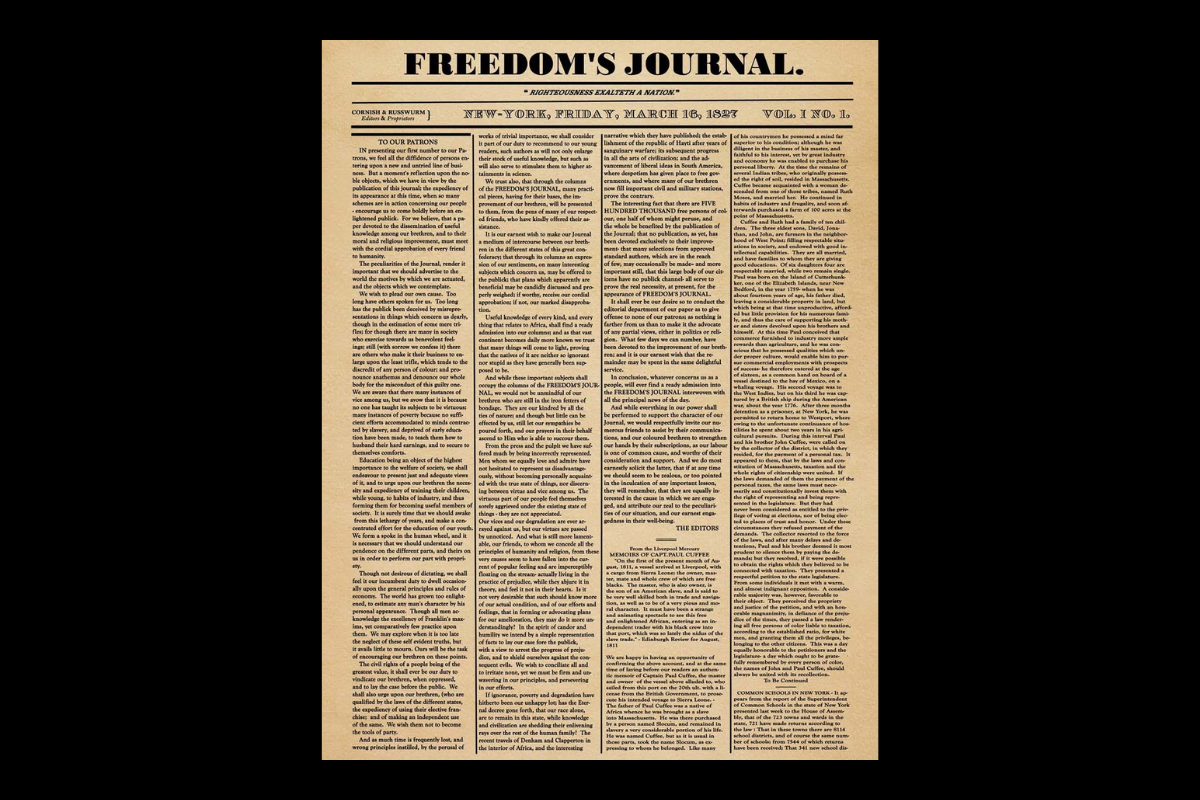
Next year marks the 200th anniversary of the founding of the Black press in New York City. In 1827, Freedom’s Journal proclaimed: “We wish to plead our own cause. Too long have others spoken for us. … From the press and the pulpit, we have suffered much from being incorrectly represented.”
Those words remain true today.
The first Spanish-language newspapers were founded in the early 1800s in New Orleans; the first Native American newspaper, The Cherokee Phoenix, in Georgia in 1828 and the first Chinese-language newspapers in California during the 1850s.
The journalists and media-makers attending this gathering today follow a long tradition of journalists and news organizations of color who have used their platforms to inform and advocate for information that serves the health and well-being of our communities.
These institutions have played critical roles in the struggle to realize and protect the rights of our communities.
Media policies and the so-called mainstream white-owned and -controlled media institutions remain a site of harm for their role in upholding racial hierarchies. We’re now witnessing the role media and tech companies are playing in the dismantling of our civil and human rights.
But how do we understand this current moment and the challenges we face, especially for journalists, media-makers and media advocates of color?
A constitutional collapse
Professor Aziz Rana, a constitutional law professor at Boston College, has described our current moment as the collapse of a mid-20th-century constitutional compact that witnessed the United States’ emergence as the only global superpower that could challenge the Soviet Union following World War II.
This forced the United States — the new leader of the so-called free world — to deal with its own contradictions as Black soldiers returned home to bolster the demands of the Civil Rights Movement, and international anti-colonial struggles against European empires pressured the federal government to expand rights for our communities.
But Professor Rana argues that our society’s veneration of the U.S. Constitution as a redemptive and just document following World War II has made it difficult to redress its inherent structural flaws and that these very flaws, and our inability to diagnose them, have now opened the door and given rise to an authoritarian government.
In his 2024 book The Constitutional Bind: How Americans Came to Idolize a Document That Fails Them, Rana details how the Constitution is actually an “anti-democratic” document in its origins that creates an “infrastructure for minority rule — a specific and very American brand of white authoritarianism.”

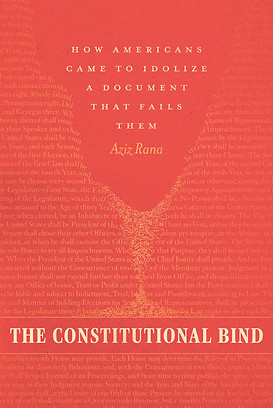
He notes the political elites who ratified the Constitution sought to protect the interests of a ruling class and their violent settler-colonial ambitions required dispossessing Indigenous nations of their land and maintaining an enslaved African workforce.
In addition, political representation for the presidency and the Senate — the two branches of government that also select and confirm our judges for lifetime appointments — are determined by geography, not the popular vote.
This century alone, two Republican presidents — George W. Bush and Donald Trump — lost the popular vote but were still elected president due to the Electoral College. And those presidents are responsible for nominating five of the six current conservative Supreme Court justices. Meanwhile, Congress impeached Trump twice this past decade, including for inciting the deadly Jan. 6 coup attempt. But the Senate failed to convict Trump on each occasion, while the Supreme Court has since expanded his presidential powers.
The Constitution provides the presidency and Congress with numerous veto powers to undermine and prevent the popular will to expand societal rights.
We have to contend with the structural flaws of the U.S. Constitution since it plays such a central role in organizing how our society and its critical institutions are structured to support our nation’s settler goals and its policies of racial subordination both at home and abroad.
Our nation’s media systems and media institutions do not live outside of this system — this constitutional order. Rather, the media have played a key role in constituting our social and political order.
The creation of our media system
At our nation’s onset, a primary function of the federal government focused on the delivery of newspapers and the construction of postal roads. By the 1830s, newspapers made up 95 percent of the mail.
In the South, enslaved Africans were initially allowed to deliver mail. But Congress passed a law in 1802 that permitted only white people to deliver the mail due to fears of revolts after the Haitian Revolution.
In a letter to a U.S. senator, Thomas Jefferson’s first postmaster general, Gideon Granger, warned:
The most active and intelligent [slaves] are employed as post riders. … By traveling from day to day, and hourly mixing with people … they will acquire information. They will learn that a man’s rights do not depend on his color. They will, in time, become teachers to their brethren … One able man among them, perceiving the value of this machine, might lay a plan which would be communicated by your post riders from town to town and produce a general and united operation against you.
By the 1830s, Southern states took action to protect this machine — this communication system — by ignoring federal law and passing their own legislation that resulted in criminalizing the delivery of abolitionist anti-slavery mail in the South.
Lost history of Colored Conventions
In 1830, Black leaders gathered in Philadelphia to host the first-ever Colored Convention to discuss, deliberate and organize strategies to end enslavement and to secure civil and human rights of Black people. The Colored Conventions lasted for seven decades and throughout, the Black press played a critical role in this struggle.
At its 1847 gathering in Troy, New York, the convention attendees debated whether to create a national Black newspaper — a national press. Newspaper publisher and minister Henry Highland Garnet supported the idea, calling it the “most successful means which can be used for the overthrow of Slavery and Caste in this country.”
Attendees also argued that the Black press served the advancement of the community as “the vehicle of thought” and a “ruler of opinions.”
Following the Civil War, the formerly enslaved created newspapers in the South to defend the adoption of historic civil-rights protections, including the ratification of constitutional amendments that abolished enslavement and granted citizenship to Black people, as well as the right to vote.
White newspapers and Jim Crow
By contrast, white newspapers in the South worked to undermine Reconstruction.
In the book Journalism and Jim Crow, the authors outline how publishers and editors at Southern democratic newspapers, like The Atlanta Journal-Constitution, were powerful actors in ushering in an era of racial apartheid. This new system resulted in an increase in lynchings and extrajudicial violence against Black people, as well as Mexican citizens and Mexican nationals.
 Edited by Kathy Roberts Forde and Sid Bedingfield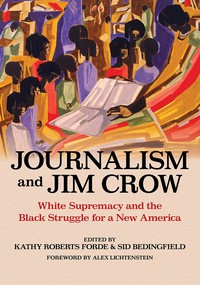
Ida B. Wells, along with other Black leaders such as Frederick Douglass, published a pamphlet in 1893 that they distributed at the Chicago World’s Fair to draw international attention to the violence and deteriorating conditions Black people faced in the years following the Civil War.
Wells addressed the central role media owners played in supporting the lynching of Black men who were being accused of raping white women.
She wrote:
The men who make these charges encourage or lead the mobs which do the lynching. They belong to the race which holds Negro life cheap, which owns the telegraph wires, newspapers, and all other communication with the outside world. They write the reports which justify lynching by painting the Negro as black as possible, and those reports are accepted by the press associations and the world without question or investigation.
The nadir
During the first 60 years of the 20th century, little changed about the role of the dominant white press in the colonial project of racial subordination.
Innovations in radio technology gave rise to a broadcasting industry during the 1920s and the creation in 1934 of a federal agency, the Federal Communications Commission (FCC), to regulate it. It would be more than a decade before the Commission awarded a radio license to a Black or Latino person, while companies that supported or profited off of segregation, including newspapers, received licenses.
To this day, we still have not had an accounting of how many companies that owned radio and TV stations supported or profited from segregation. During the 1950s and early 1960s, for example, ABC (then known as American Broadcasting — Paramount Theatres) owned and operated segregated movie theaters. This should be common knowledge, but it’s not, even though it shaped the media landscape we are still contending with today.
Meanwhile, white-owned newspapers resisted integration, a point that Mississippi Sen. James O. Eastland, a notorious segregationist, noted and supported when he spoke to the American Society of Newspaper Editors (ASNE) in 1948 in Washington, D.C. He said:
There are thousands of Negro reporters in this country, yet the newspapers do not draw 10 percent of their reporters from that race. … You are not to be condemned. It is your civil right to associate with, employ and work with whomever you please.
The rupture
Professor Rana argues that our communities have been able to expand rights during times of political rupture in our society, which occurred following the Civil War and World War II.
This resulted in the passage of historic civil-rights protections during the Civil Rights Movement, including the 1964 Civil Rights Act, which ended segregation and made workplace discrimination illegal at public and private institutions.
Nevertheless, the media industry was slow to integrate.
The Community Relations Service, an agency within the Department of Justice, stated in 1969 that: “Few American institutions have so completely excluded minority group members from influence and control as have the news media. This failure is reflected by general insensitivity and indifference and is verified by ownership, management, and employment statistics.”
During the 1970s, newspapers and TV companies began to integrate their newsrooms. The ANE adopted a goal in 1978 for the industry to reach racial parity by 2000. It didn’t come close.
The retrenchment
We need to account for the role powerful media institutions and media policies have played in what we should understand as crimes against humanity — genocide, enslavement and apartheid.
The rise of right-wing movements at home has severed our nation’s commitment to policies of racial liberalism and ushered in our current era of racial retrenchment.
The 2020 racial-justice uprisings once again reflected the failure of media institutions to integrate their workforces and structural policies in creating a more just media system.
And earlier this year, Trump said the passage of the 1964 Civil Rights Act treated white people badly, calling it “reverse discrimination.”
This sentiment is also shaping the work of the FCC, which is investigating companies and pressuring them to abandon even their limited DEI programs, threatening their licenses, and allowing massive media mergers to Trump-friendly companies that support the administration’s authoritarian goals.
This is happening as the financial structures to support journalism are collapsing, giving rise to a growing policy struggle to determine the future of journalism, which our communities are currently not well positioned to contest. And media outlets owned and controlled by people of color remain undervalued and under-resourced while being constantly asked to prove themselves despite the sector’s 200-year record.
Reconstruction of our society is critical to our communities’ short-term and long-term well-being. This means the reconstruction of our media system and media policies that support racial subordination — this means media reparations.
So what are the questions we should be asking ourselves? What are the ideas we need to build popular support to strengthen our media institutions?
And like the media pioneers from our communities before us, how are we positioning media and media policies as a central part of expanding rights and powers for our communities? What is our role in the struggle to achieve a just society that our communities and the people that we love deserve?
About the author
Joseph Torres is Free Press’ senior advisor of reparative policy and programs. He advises the co-CEOs and other key Free Press staff in setting and evaluating the organization’s policy positions and priorities. Joseph is also a co-founder of the Media 2070 project and is a visiting scholar at the Media, Inequality & Change Center at the University of Pennsylvania’s Annenberg School for Communication.