The AI Industry Is Running the Polluters’ Playbook
We’ve seen these tactics before, and there’s still time to do something about it

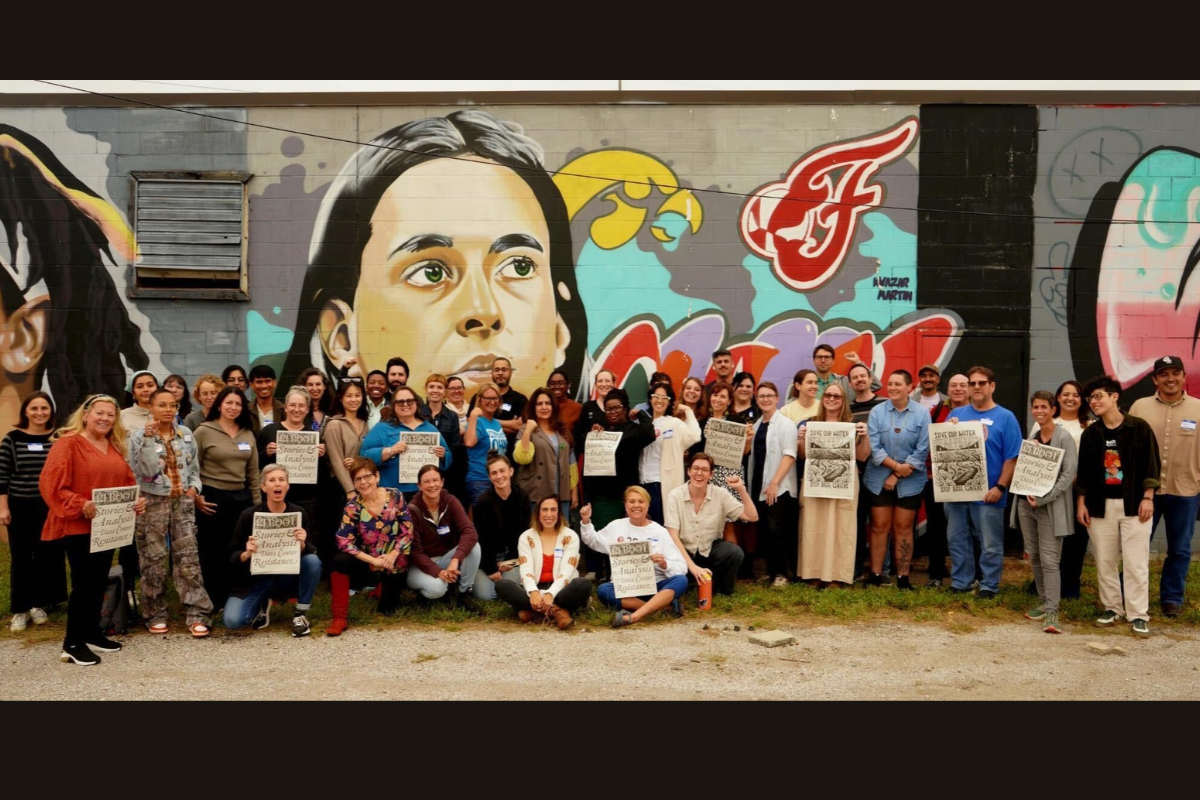
Editor’s Note: The following is an edited transcript of a speech that Free Press’ Jenna Ruddock delivered at the Life After Data conference hosted by the Georgetown Law Center on Privacy and Technology on Oct. 6.
In the opening chapter of her seminal work Silent Spring, Rachel Carson drops us into “a town in the heart of America” where a “strange blight has crept” in. Livestock began falling ill. People, too. Birds had gone silent, and bees wouldn’t arrive to pollinate the fruit trees that spring.
Carson writes:
This town does not actually exist; I know of no community that has experienced all the misfortunes I describe. Yet every one of them has actually happened somewhere in the world, and many communities have already suffered a substantial number of them.
A grim spectre has crept upon us almost unnoticed, and soon my imaginary town may have thousands of real counterparts.
The chapter is titled “A Fable for Tomorrow,” and over the past several years I’ve heard echoes of Carson in town halls, community meeting spaces, libraries and living rooms all across the country.
Carson was describing the effects of DDT — a carcinogenic insecticide whose rapid integration into every aspect of our lives, from industrial applications to commercial and household products, is now hard to fathom.
You can hear these echoes in stories from Sterling, Virginia, where residents described being able to feel in their lungs that a nearby Vantage data center’s backup diesel generators were running even when the skies were already choked with Canadian wildfire smoke.
I’ve seen it in Monrovia, Indiana, where families’ views from their front yards — once farmland to the horizon — now look out on a barbed-wire-topped fence encircling a 400-acre Google data center campus.
I’ve heard it from people in Memphis — ranking seventh in the country for asthma-related deaths — who know intimately the long tail of industrial pollution and its racialized burdens. They have spent two years now fighting what the Southern Environmental Law Center describes as illegal power plants — dozens of unpermitted gas turbines, all emitting carcinogenic chemicals like formaldehyde and fine particulate matter that contributes to asthma, heart attacks and strokes.
Elon Musk’s xAI installed the turbines to bring the data center campus dubbed Colossus online at record speed — and then did it again, just across state lines in Southaven, Mississippi, to power Colossus 2.
None of these communities were offered a meaningful say in what their futures now look like. They’ve had to fight for it — and the companies responsible for the frenzied data center buildout across the U.S. have made sure of that.
New chapter, same story
Silicon Valley’s so-called AI race is being powered by tactics that are familiar to communities that have long histories with industrial exploitation. These are tactics that have been perfected by the Exxons and Chevrons, Shells and DuPonts of the world — by industries that have locked us into our current present of extraction, extinction and precarity.
Tactics like the weaponization of trade-secrets laws and nondisclosure agreements, making it impossible for communities to judge projects’ real risks to their health, their quality of life and the environment before shovels are in the ground. According to reporting by New Orleans Public Radio, nearly 80 percent of Louisiana’s state senators have signed NDAs over development projects, including with Meta to protect the company’s Hyperion project in Richland Parish — a data center campus that will require 10 new dedicated power plants to operate and that Mark Zuckerberg initially pitched as being nearly the size of Manhattan. OpenAI’s deal with Georgia Power — for a data center facility in Effingham County that would be the “largest single-user of power in Georgia’s history” — was redacted in its entirety.
Tactics like threatening communities with lawsuits they cannot afford for daring to say no — as in the case of Related Digital, the developer of a massive OpenAI and Oracle data center campus in Saline Township, Michigan, which sued the town after it denied a rezoning request necessary for the project to go forward.
Tactics like undermining public-hearing processes and skirting permit requirements entirely, which xAI has done in Memphis and Southaven for Colossus 1 and 2. DataOne made a similar choice in Vineland, New Jersey, by installing and operating 62 gas-powered generators without permits. That project, one of the largest data centers on the East Coast, is part of a $17 billion deal with Microsoft and Dutch AI infrastructure company Nebius. In May, Anthropic signed a deal with xAI to use Colossus 1 despite ongoing community resistance and litigation.
Or like trumpeting temporary contributions to the local tax base through ad campaigns while exploiting billions in government subsidies and tax credits. Meta, worth close to $2 trillion, is avoiding nearly $4 billion in taxes through just one tax credit by claiming its data center projects are “a giant experiment that could fail.” Meta will pocket another $3.3 billion tax break for its data center in Richland Parish alone.
A grim world order
You cannot separate how a technology is built from the future it will usher in. In his 1980 essay “Do Artifacts Have Politics?” political theorist Langdon Winner observed that “the things we call ‘technologies’ are ways of building order in our world. … The issues that divide or unite people in society are settled not only in the institutions and practices of politics proper but also, and less obviously, in tangible arrangements of steel and concrete, wires and transistors, nuts and bolts.”
When you look at how the data center buildout is happening in service of the so-called AI race in the United States, the order being built is a grim one. It requires a future of brute force, of corporate supremacy enabled by government complicity, through an eroding of democratic rights. It is a future where legal protections for entire communities and ecosystems are cast aside for the pet projects of the world’s richest men.
It’s a future where communities have no right to say no, where choices don’t rest with us because they have been extracted from us. It’s a future where our school budgets and health-care funding are instead lining the pockets of tax-evading companies with hundreds of billions of dollars to spend on speculative infrastructure in the service of a singular vision for technology that’s reliant on sheer scale and increasing financial precarity.
Is the future for everyone?
Communities are responding with tactics of their own. These tactics propose a different future.
People are gathering in libraries and in each other’s living rooms, many meeting neighbors for the first time. They’re crowdsourcing fundraisers to raise legal fees and fight multibillion-dollar corporations, packing public meetings in the dozens and often hundreds, collecting tens of thousands of signatures at concert tailgates and through door-knocking campaigns to put community control over data centers on their state ballots.
They’re flying drones and small piloted flights, and installing community-owned air monitors to gather evidence and demand regulatory enforcement.
They’re squeezing in public-records requests and technical-document review between their full-time work as parents or as small-business owners.
Many are running for office.
Their visions for the future are as varied as their lives. People want to enjoy the home they hoped to retire in, like in Ashburn, Virginia. They want to sleep soundly, without the persistent hum of turbines and cooling systems cutting through the night, like in Southaven, Mississippi. They want to have a meaningful say in determining what’s best for their community over the long term, to not be constrained by just solving next year’s budget. People in west Texas and central Arizona want to protect their water from one more source of extraction during an age of escalating water stress and drought. In Memphis, people want to breathe.
When companies leading — and poised to profit most from — this race to build AI infrastructure talk about the future, we hear compelling promises. AI will “fix the climate,” according to OpenAI’s Sam Altman. Elon Musk says AI will lead to “universal high income.” Meta’s Mark Zuckerberg recently published a manifesto claiming that, thanks to what the company’s building, “the future is for everyone.”
But the reality on the ground, in communities where this infrastructure is being built, tells a different story. And it begs the question: If the companies leading the AI race are given everything they feel entitled to, what will the future look like?
Or we can ask a different question.
If our communities have the power to meaningfully choose, what does the future look like instead?
About the author
Jenna Ruddock supports Free Press’ policy, legal and communications work across issue areas, with a focus on technology, surveillance, digital civil rights and dissent. Follow Jenna on Bluesky.
Open tabs
Compiled by Pressing Issues editors
About that stock price. Skydance’s stock fell sharply on Wednesday after the newly merged Paramount-Warner Bros. Discovery company handed out warrants to former Paramount Skydance investors, Variety reported.
 Todd Spangler
Much of the drop was a technical reset, but it lands on a company carrying $79 billion in debt. And as Free Press’ S. Derek Turner told Pressing Issues last week, the pressure to pay down that debt while keeping Wall Street happy means “workers and the public are paying the price” for David Ellison’s “shiny new toy.”
For those keeping track, Variety also noted that Skydance now has a market valuation of $40 billion, which is $38 billion less than what Paramount paid ($78 billion) to buy WBD.
About that White House press ban. On Tuesday night, a federal judge indefinitely blocked President Trump’s ban on CNN, MS NOW and Politico. The Justice Department says it will appeal.
Free Press, which joined nearly 80 press-freedom groups and news organizations in an amicus brief supporting the outlets, welcomed the decision.
“Donald Trump cannot unilaterally revoke journalists’ press access because he doesn’t like their coverage or questions. Judge Kelly’s strong ruling affirms that presidential cherry-picking of newsroom access violates core First Amendment principles,” Nora Benavidez, Free Press’ senior counsel and director of digital justice and civil rights, said in a statement about the ruling.


The kicker
“Communities couldn’t be clearer about their demands in the face of the frenzied data-center buildout: more public oversight and community control, not less” —Jenna Ruddock at Food & Water Watch