El Grito in the Time of ICE Killings
How LULAC’s new digital-only newsroom is leading with community-driven journalism

Last week, ICE agents in Houston shot and killed Lorenzo Salgado Araujo, a father of three who had lived in the United States for 35 years. The Harris County Medical Examiner has ruled his death a homicide.
Three men who survived the shooting, including the victim’s brother, dispute the Department of Homeland Security’s claim that Salgado Araujo “weaponized his vehicle” and that the ICE agent fired in self-defense. Civil-rights and immigrant-advocacy groups condemned the killing.
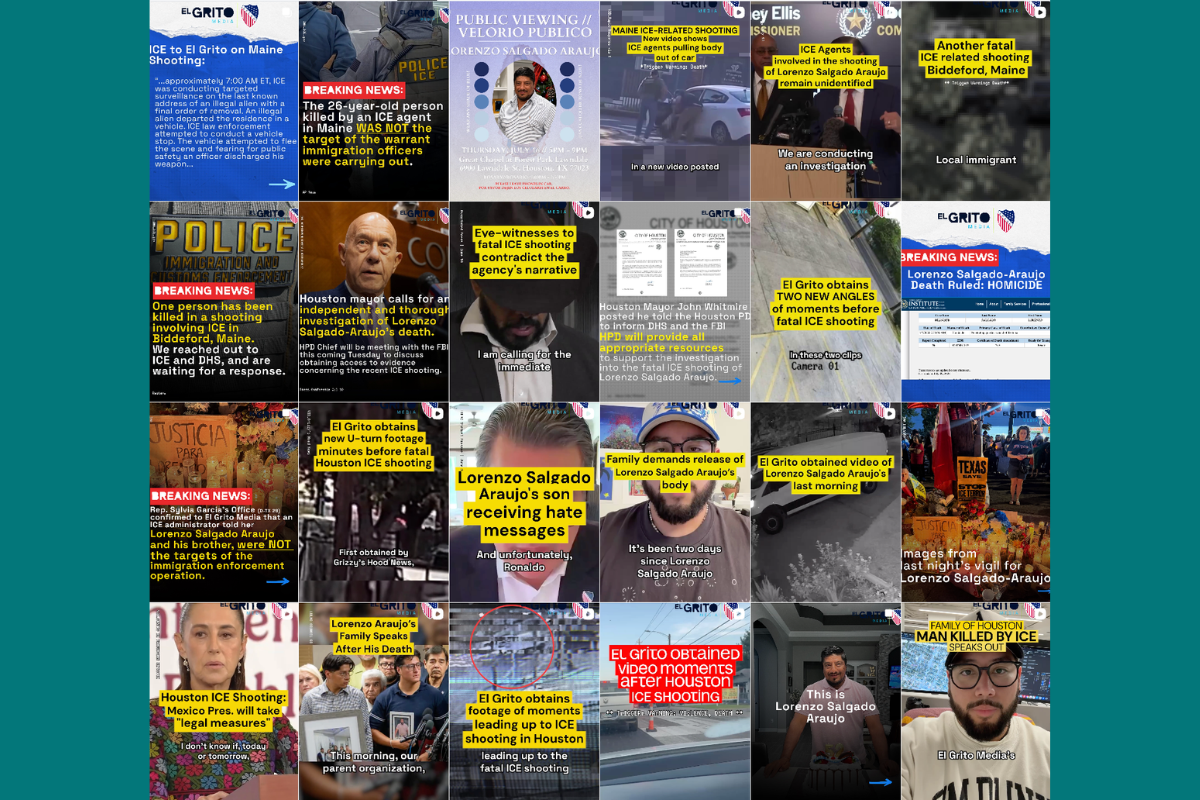
I didn’t first hear about the shooting from CNN or The New York Times. I was on vacation, half paying attention to my phone, when a video showed up in my Instagram feed — footage from the scene, posted by an account I didn’t recognize: El Grito Media.
I started following and saw that some of their videos were getting millions of views. El Grito is a community-journalism newsroom that LULAC — one of the nation’s oldest and largest Latino civil rights-organizations — launched last year. The El Grito newsroom is editorially independent from the group. Within days, CNN was citing its footage.
I wanted to talk to El Grito Editor-in-Chief Arleen Aguasvivas about how a three-person newsroom ended up ahead of the national press on this story. I spoke with her on Monday, the same day that ICE agents shot and killed another man, 26-year-old Joan Sebastian Guerrero, in Biddeford, Maine, during an attempt to serve a warrant on someone else. It was the second time in a week that ICE agents had stopped the wrong vehicle and killed someone. This is all happening at a time when ICE arrests have spiked to approximately 2,000 a day.
The interview was edited for length and clarity.
Julio Ricardo Varela: Can you just tell me why LULAC formed El Grito Media? What is the relationship between the newsroom and the organization?
Arleen Aguasvivas: LULAC CEO Juan Proaño started this initiative last year. And he saw that he was having trouble getting some of the stories or issues concerning the Latino community out to major outlets, or that those pitches were just not going anywhere fast. And he was also receiving many tragic stories and messages from the community, and he was concerned about getting them enough attention.
So he kind of shifted the organization’s Instagram to become a source of information. I joined the team in April from NBC. I decided to brand the newsroom, separate it, and make it a distinct entity from LULAC. We launched El Grito Media.
Whenever you see us, we still use the reach that LULAC already has, but we make sure we brand our content. If it’s journalism, we’re very transparent. It’s El Grito Media, and that’s the logo it has on Instagram. Because of the collaboration feature, LULAC can tag or collaborate with El Grito’s profile, making it clear that this is journalism.
Our mission dictates what we cover, not how we cover it. We practice rigorous reporting. We verify and receive comments from all involved parties. We don’t use sensational language. We don’t use emotional triggers or fear to get people to click. It’s just factual information, as best as we possibly can. We’re transparent about the mistakes we make because it’s only natural. We have a very transparent correction policy. We will pin the comment. We don’t change things in secret and then not tell anybody. We interact with people in the comments.
JRV: So is there a firewall between you and LULAC editorially? Are you independent?
AA: We’re independent, yes. Juan gives us ideas. He was the one who flagged the Houston shooting when it happened. But he is not involved in approving scripts. He is not involved in deciding what we cover. We have the final say. We’re editorially independent.
JRV: How big is the newsroom?
AA: We have three staff members right now, plus student journalists.
JRV: Why do you think all of a sudden you’re getting attention from corporate media?
AA: One of the central tenets of El Grito is that we are community-based reporting. We are beholden to the Latino community and its allies. So we don’t cover all breaking-news stories. We cover the breaking-news stories that truly matter or are currently impacting our community.
And because we’re community-based, and one of if not the oldest Latino civil-rights organization in the country, there is an automatic community-based network of sources, and those are reliable community leaders who are telling us what is happening on the ground. Some of the first videos we verified came from someone who emailed LULAC to say his friend, the mechanic down the street, had surveillance footage of the incident.
This is a testament to my student journalists and my staff journalists — we went over editorial standards ad nauseam. This is what journalism is. This is our standard operating procedure. And the way that they’re approaching this story is at the level, if not better, than what I’ve seen from producers who have years in the newsroom. They’re hungry, and I think part of that is because they see the impact that sharing accessible information to the community can have.
JRV: I just saw the videos you did about the shooting in Maine. You turned them around quickly. But then I saw that you collaborated on Instagram with a couple of organizations. Tell me about that strategy.
AA: This first started when El Grito journalist Andy Perez and I were covering the Delaney Hall protest in New Jersey. I was sourcing information from grassroots organizations that had relationships with the people affected. We always ask ICE for comment, as well as the GEO Group, the company that runs the detention center, but we also had a direct line to the people who were impacted. We don’t center national organizations or the big names. We center the people who are impacted, and as such, we try to elevate these local organizations, both as our sources of information and to give them the roses and the platform they deserve. And we also uplift their work, rather than just using them as a source.
JRV: What do you think makes your coverage stand out as people are just starting to find out about you?
AA: We’re really, really transparent. Everything that we say, every single line, is sourced. Even in the videos, we put our source along the side. When we’re doing carousels, if it’s a think tank, we also include their lean: left-leaning, right-leaning or center. We’re so clear about where we’re getting our information. And it’s accessible. We talk like we’re talking to your primo or brother. We translate not just between languages, but also from the national to the local. Our little catchphrase is that we’ve mastered the art of code switching.
About the author
Julio Ricardo Varela is the senior producer and strategist at Free Press. He is also a working journalist, columnist and nonprofit-media leader. He is a massive Red Sox, Knicks and Arsenal fan (what a combo). Follow him on Bluesky.
Action news
Antitrust Lawsuit FTW. On Monday, 12 state attorneys general led by California’s Rob Bonta launched an antitrust suit to block the proposed $111 billion merger between Paramount Skydance and Warner Bros. Discovery.
“The unlawful merger of these two entertainment behemoths would lead to higher prices, lower quality, and less content for film and television, harming movie theaters, basic cable distributors, and ultimately, audiences on every sofa and movie theater seat in the U.S.,” Bonta said in a statement announcing the lawsuit. His office was joined by attorneys general from Arizona, Colorado, Connecticut, Massachusetts, Minnesota, Nevada, New Jersey, New Mexico, New York, Oregon and Washington.
Free Press thanks these state attorneys general for listening to the hundreds of thousands of people who have taken action to oppose this mega-merger.
“President Trump and his cronies want to rush this anti-competitive deal through because David Ellison has demonstrated time and again that he will leverage his control of his media empire to silence Trump’s critics and amplify MAGA propaganda. That’s corruption, plain and simple,” Free Press co-CEO Jessica J. González said.
Read more about what Free Press said about the lawsuit.


The kicker