First on the Scene at Delaney Hall
Organizers committing acts of journalism are shining a light on ICE atrocities

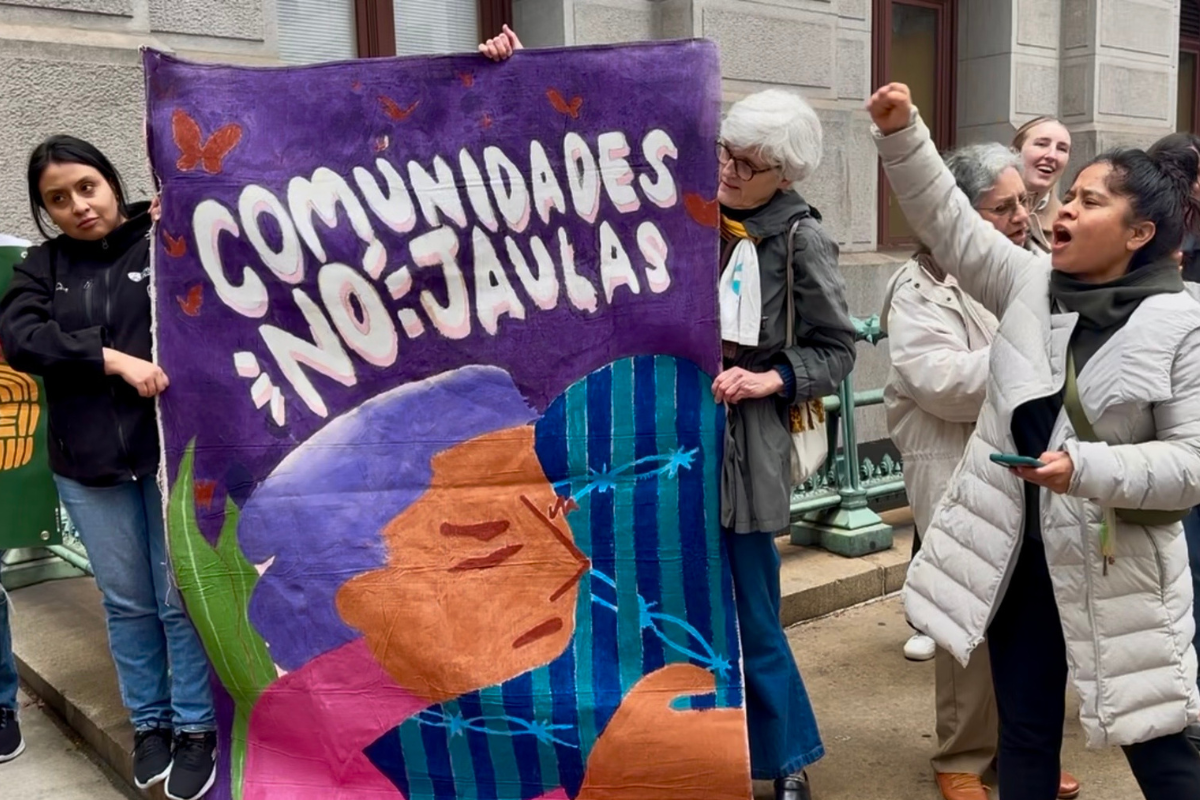
For more than a year, New Jersey immigrant-rights organizations have been sounding the alarm about inhumane and oppressive conditions inside Delaney Hall, a Newark detention center the prison giant GEO Group owns. Hundreds of detainees at Delaney Hall have been on a hunger and labor strike for nearly two weeks, protesting the lack of medical care in the facility, overcrowding and lack of air conditioning. Detainees are also forced to work for $1 a day, are served rotten food with maggots in it and are denied visitation with their families.
The response from the detention center has been more repression. Detainees allege guards have violently attacked them instead of negotiating with them.
Organizers with immigrant-rights organizations from across New Jersey, along with the families of the detainees, have been protesting outside the detention center to demand the release of the people being held at the facility and the closure of the detention center. Groups like Cosecha New Jersey, El Pueblo Unido de Atlantic City, Radio CATA, Radio Jornalera, and the SJ Solidarity Collective have been livestreaming the protests each night. They have been documenting the brutal arrests of protesters, the violence at the hands of the New Jersey State Police and the infringements on the First Amendment rights of observers, activists and journalists.
Many elected officials, including New Jersey Gov. Mikie Sherrill, were denied entry when they came to Delaney Hall to inspect the conditions inside. As the protest and calls to close the detention center grew louder, Sherill summoned the state police to manage the crowds of protesters, journalists and livestreamers.
Over the last weekend in May, the protests intensified, and both state police and ICE agents brutalized the protesters and journalists, attacking them with pepper spray, rubber bullets, tear gas, smoke grenades and other harmful projectiles. Newark Mayor Ras Baraka — who himself had been arrested when he tried to enter Delaney Hall months earlier — enacted a curfew, which was later lifted, and urged protesters to remain peaceful. Livestreams show police initiating the violence in many cases.
Dozens of people were injured, and more than 60 people were arrested for protesting in front of the detention center. Some face felony-rioting charges, and many were arrested in Gov. Sherrill’s designated “protest zone.” Others, including members of the press, were trying to leave the area when state troopers violently accosted them. Police even pepper-sprayed U.S. Sen. Andy Kim. Newark police have since taken over policing the protests.
Storytellers on the line
Before the protests at Delaney Hall started over a year ago, immigrant-rights organizers had been putting their bodies on the line and risking arrest to share critical information to keep their communities safe. Immigration-enforcement operations have increased over the past year, especially in South Jersey, where many farmworker communities are located.
Immigrant-rights organizations have had to create social media content and deploy citizen journalists to alert the public about ICE. They have a direct line of communication to New Jersey’s immigrant population, who are vulnerable to ICE arrests and harassment. Organizers have been using every tool available to them to keep people out of dangerous places like Delaney Hall.
In addition to informing people about immigration-enforcement operations, organizers have been advocating for an end to the repressive conditions at detention centers in New Jersey. In May 2025, when protests started at Delaney Hall, they were the first ones on the scene, where they amplified the voices of detainees and shared stories about how people were being abused. Since then, organizers have been working around the clock to get detainees released and keep people from being sent to the detention centers.
Their First Amendment rights must be protected.
What organizers told me
I’ve spoken with a number of the organizers and media-makers across the state about the work they’re doing.
Cristian Moreno-Rodriguez, executive director of El Pueblo Unido de Atlantic City, has spent the last two weeks at Delaney Hall reporting from the protests. He discussed his work informing the community about ICE while at a Free Press Action event in Camden last fall.
“We don’t spread fear; we spread empowerment, and so we post minute by minute where they are,” he said. “We track them throughout our neighborhoods. It’s our First Amendment right to document this. We don’t impede any investigation; we don’t obstruct, but we document where they are. We’re delivering information to our community in ways traditional media outlets can’t. Telemundo is not there giving know-your-rights information while ICE agents are in the community. We’ve also been documenting throughout the state what’s happening in order to educate our people on the atrocities happening.”
Edgar Aquino-Huerta is an organizer with CATA, a Bridgeton, New Jersey, organization focused on workers’ rights, immigration and food justice. He’s part of the rapid-response network that deploys to farms and farmworker camps to inform people about ICE sightings, share know-your-rights information and cover ongoing protests at Delaney Hall.
CATA is working with a group of immigrant-rights organizations to increase their reach, ensure as many people as possible see what’s happening at Delaney Hall and amplify the stories of people being detained. The groups are consolidating their livestreams so that if any one of them streams from the detention center, it appears on all of their social-media platforms. They’re also supporting each other through community-defense groups (Defensa del Barrio), where they use rapid-response networks to inform immigrants about ICE sightings and teach people how to exercise their rights.

Even though CATA has a low-power radio station that broadcasts to the farmworker community in South Jersey, Aquino-Huerta tells me the primary way they share information is through social media and word of mouth. He explains the challenges of informing immigrant farmworkers about what’s happening at Delaney Hall and with ICE.
“It’s been really hard informing people in the last 13 days,” he said. “Something new happens every day, and social media is the primary way we inform people. But unless they see our faces and listen to it coming from our own mouths, they might not listen. They trust us. We visit farms and campsites, and we canvass the community to continue amplifying what's going on.”
This work needs public support
CATA is one of dozens of New Jersey Civic Information Consortium grantees. NJCIC is an independent organization that receives public funds to support local news-and-civic-information projects. Even though the NJCIC funds projects that provide critical news and information to media-deficient communities like Bridgeton, Gov. Sherrill has cut the consortium’s funding in the proposed state budget for next year.
Free Press Action is engaged in a campaign to restore NJCIC funds so that groups like CATA can continue their efforts to inform the community about ICE and immigrant rights. These groups, as well as the many impactful NJCIC-funded local-news projects that fill important information gaps in New Jersey, deserve our support. They are on the frontlines of the fight against unlawful ICE operations, and they’re the first line of defense for immigrant communities.
At a time when commercial media outlets are failing their communities, the work of groups like CATA demands — and deserves — public support.

Trusted messengers
The organizers who are tracking ICE and reporting on the inhumane conditions inside the detention centers in New Jersey face violence and arrest simply for covering what’s happening. They may not all be traditional journalists, but they are practicing journalism and telling the untold stories we all need to hear.
Their efforts to provide culturally relevant information in Spanish to immigrant communities across the state should be considered just as essential as traditional media sources — if not more so — and their projects should be fully funded by foundations and journalism-support organizations. Without them, our communities would be less aware — and less safe. We need trusted messengers like these to provide critical information and to amplify the stories of the people most impacted by immigration enforcement operations.
I asked Aquino-Huerta what he thought of the protests — and the corresponding crackdown — at Delaney Hall. “I think the protesters inside are very brave,” he said. “They are being courageous enough to speak up about their current conditions. Many are not aware of the difference that it’s making out here. I hope they can shut down Delaney Hall, and they can release the detainees from there.”
About the author
Vanessa Maria Graber is the senior director of journalism and media education at Free Press. She creates resources for newsrooms and trains journalists about civic-journalism best practices, community engagement and First Amendment rights. Follow Vanessa Maria on Instagram @newsjawn.
Teamwork
Compiled by Pressing Issues editors
Big tech facilitates ICE surveillance. Free Press Advocacy Director Jenna Ruddock wrote a piece this week for Tech Policy Press about how the federal government’s use of tech against ICE protesters at places like Delaney Hall has become a standard operating practice designed to intimidate and silence free expression.
“The strikes and related demonstrations are an urgent reminder that the Trump administration continues to target ICE watch efforts for one clear reason: impunity thrives without witnesses,” Ruddock writes.
 Jenna Ruddock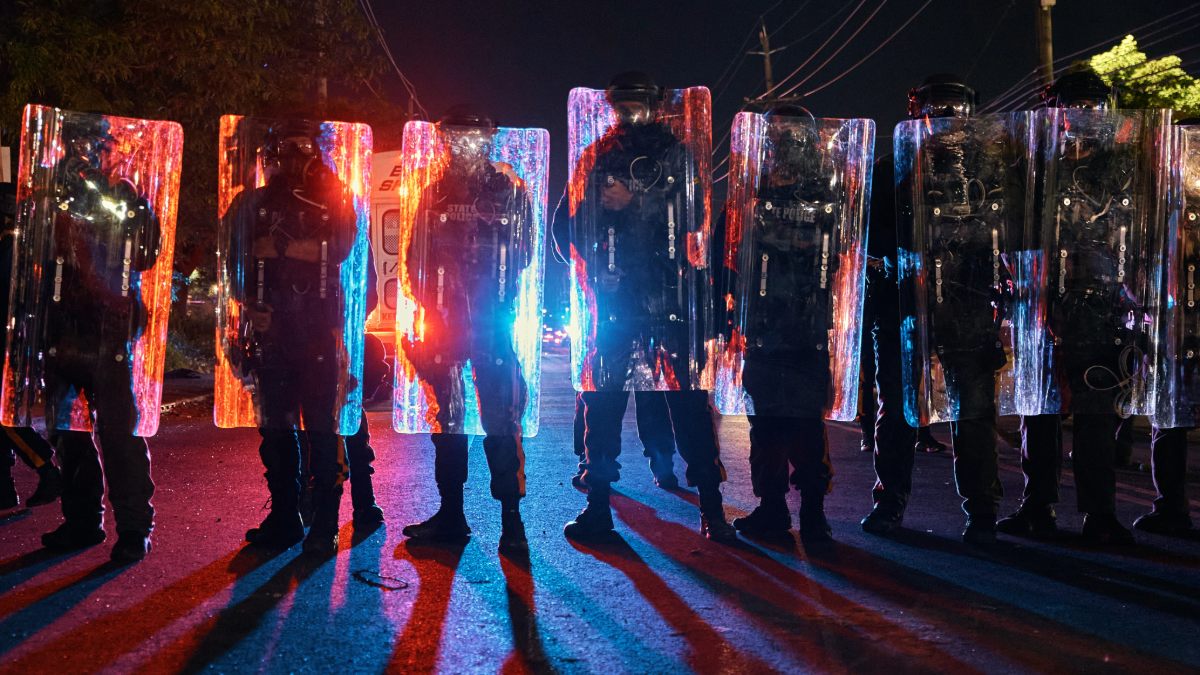
Smooth operator. In more New Jersey news, Montclair State University submitted a winning bid as the new operator of the state’s public-media system. For the first time in years, the people in charge of New Jersey’s public media will actually live in New Jersey. Even better news: Montclair State has shown a commitment to community journalism through its work building the Center for Cooperative Media and partnership with the New Jersey Civic Information Consortium.
Montclair State also solicited the New Jersey Public Media Ecosystem Report that Free Press’ Mike Rispoli wrote about for Pressing Issues in May. That effort shared a vision where “people across New Jersey have access to innovative, independent and sustainable public media that informs, educates and reflects their communities.” Now there’s an opportunity to put these ideas into action.
 Mike Rispoli
The kicker
“Arresting reporters for covering protests is not law enforcement; it is the criminalization of the First Amendment …. This type of behavior has no place in a democracy.” —CPJ Américas Director Jose Zamora